Industry Review: Why 808nm/810nm Diode Laser is Essential for Modern Clinics

Introduction
Hair removal by lasers has now become an indispensable part of aesthetic practices throughout the globe. From many different types of lasers available, diode lasers with wavelengths of either 808nm or 810nm have proven themselves as the absolute industry standard due to the excellent level of safety, high skin compatibility, and efficient treatment results. They have been replacing light technologies in the market over time and have become the must-have equipment for contemporary aesthetic practices.
Technology Overview: Why 808nm/810nm Diode Laser is Modern Hair Removal
Selective Photothermolysis
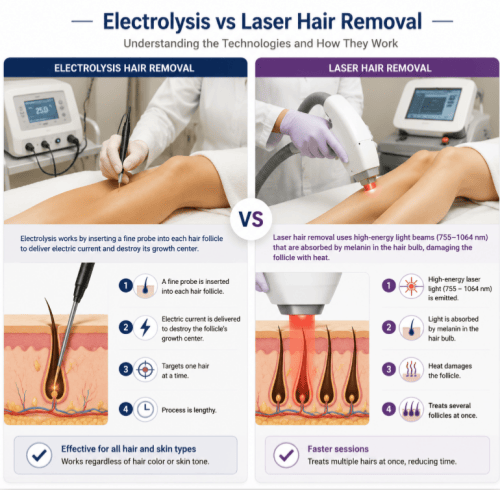
All 808nm diode laser hair removal systems operate on the basis of a phenomenon known as selective photothermolysis. Essentially, this means that laser energy targets melanin in the hair while avoiding damage to the epidermis above it. 808nm wavelength diode laser hair removal uses laser energy to penetrate the epidermis and reach dermis, where the melanin absorbs the energy and transforms it into heat which thermally destroys the follicle cells responsible for regrowth.
FDA approved 808nm diode lasers offer variable energy fluence of 5-100J/cm² and frequency of 1-10Hz. This gives practitioners total control over the amount of energy delivered to each follicle. All modern 810 nm diode laser hair removal reviews highlight a wavelength which combines high melanin absorption with enough penetration (3-4mm) to affect the deepest follicles.
Comparison to Other Lasers and Intense Pulsed Light
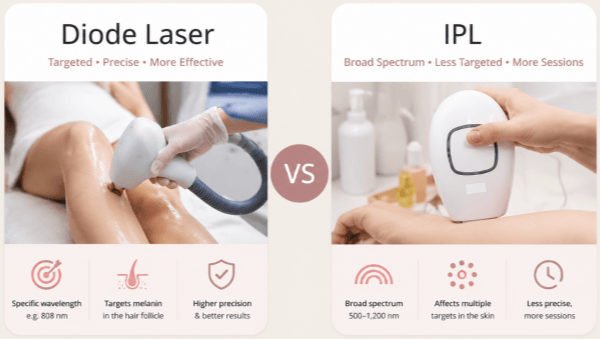
808nm/810nm Diode Laser. Workhorse wavelength. Optimal combination of melanin absorption and penetration. Suitable for all Fitzpatrick skin types (I-VI). Effective 808nm diode laser hair removal technology with low risk of epidermal injury if cooled properly.
Alexandrite 755nm. High melanin absorption, but shallow penetration. Effective on light skin (Fitzpatrick I-III). Dangerous on tanned/dark skin due to higher risks of burn injury and hyperpigmentation.
Nd:YAG 1064nm. Lowest melanin absorption, deepest penetration. Safest choice for dark Fitzpatrick V-VI skin, but requires higher fluence, long pulse duration, and more treatment sessions. Hard to use on fine/light hair.
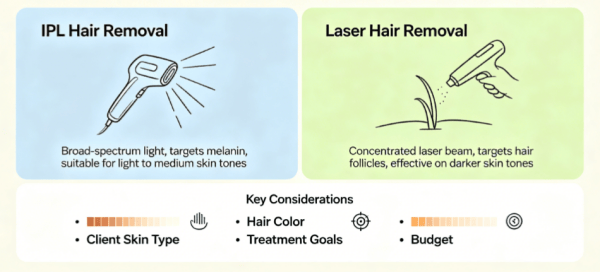
IPL (Intense Pulsed Light). Due to a broad light spectrum range (500-1200 nm) effectiveness is greatly reduced. More sessions required. More frequent consumables purchases.
Fitzpatrick Safety – Compatible with All Skin Types
Well-designed professional laser hair removal equipment using 808nm wavelength can safely perform procedures on all skin types (Fitzpatrick I-VI), even tanned. When performing procedures on darker Fitzpatrick IV-VI skin, longer pulses (30-50 ms) and lower fluence (10-18 J/cm²) should be applied using continuous cooling. Additionally, triple wavelength (755 nm + 808 nm + 1064 nm) machines enable safe treatment of all skin types.
Hardware Quality Deep Dive: What Makes Professional vs. Consumer Units
When you start researching diode laser hair removal devices, chances are that the review material is very shallow. However, writing an 808nm diode laser hair removal review requires looking into some technicalities.
Power Supply Circuitry – Building Blocks of Consistent Fluence
The laser hair removal machine cannot be any more powerful than its power source. The generator takes AC electricity and converts it into DC power for driving the laser diode bars. Variability in current means variability in fluence, which means inconsistency in clinical results.
Premium diode laser hair removal devices are equipped with advanced switching-mode power supplies allowing for ±2% current regulation regardless of varying loads. Entry-level models come with simpler solutions, which start drifting once the generator becomes hot enough after 30 minutes of continuous usage. IEC 60601-1 and IEC 60601-1-2 (electrical safety and electromagnetic interference protection standards, respectively) should definitely be met.
Laser Diode Bars – The Core Element of Diode Laser Hair Removal Devices
Laser diode bars generate photons during hair removal treatments. Manufacturers usually buy these parts from proven foundries like Coherent, Jenoptik, or nLight. Such premium bars are rather pricey and constitute about 20–50% of the entire premium device cost.
Diodes by premium foundries can handle up to 50 million shots or up to 20,000 hours of non-stop working time. Cheap devices employ off-the-shelf Chinese laser diodes, which can last no longer than 3–5 million shots (versus 10–20 million), have tendency to overheat, feature inconsistent energy density, and rapidly lose output power in 6–12 months.
While analyzing smart diode laser hair removal reviews, look for mentions of manufacturer and provenance of laser diodes. High-end OEMs like Jingyue explicitly state that their laser bars are made by Coherent or Jenoptik and have known lifetime.
Active Cooling System – The Concept of TEC Sapphire Contact Cooling
Fluences higher than 20 J/cm² bring a number of side effects: burns, post-inflammatory hyperpigmentation (PIH), excessive pain. Therefore, a good active cooling mechanism is essential for 808nm diode laser hair removal.
Premium platforms are equipped with thermoelectric coolers (TEC), which keep sapphire window surface at −4°C to +4°C temperatures. During every pulse, the cool window helps reduce increase in melanin temperature in upper epidermis layer by up to 40%, but follicle achieves necessary 65–70°C temperature.
Critical figures of merit: heat extraction capacity (≥2.5 W/cm²), cooling response time (<1 second), and temperature monitoring with thermistor. Top-of-the-line designs include antireflection coated (AR) optical-grade sapphire with a guaranteed lifetime of more than 50,000 shots. Cheaper platforms feature simple glass or just thin sapphire, which leads to hot spots and delamination.
Single vs Triple-Wavelength 808nm Diode Laser Hair Removal Machines
Classic 810 diode laser hair removal machines operate with one wavelength only. However, your clinic may see a variety of different patients. That is why triple-wavelength systems, which offer wavelengths of 755 nm, 808 nm, and 1064 nm in one probe, are especially important today.
Triple-wavelength diode laser hair removal system will allow to treat patients from Fitzpatrick scale groups I–III with fine superficial hair using 755 nm; standard densities from groups II–V with 808 nm; deep follicles of patients belonging to groups IV–VI with 1064 nm.
As for distributors, they need to offer triple-wavelength systems to stand out among competitors.
Market Landscape: Western Premium Brands versus Chinese OEM/ODM Manufacturers
China is a core component of the worldwide supply chain in professional diode laser hair removal devices since its advanced specialization in aesthetics medical device manufacturing allows for the production of scale-certified equipment. Consumers will have two different types of suppliers: western premium brand companies, as well as OEM/Odm manufacturing plants in China.
Category One – Traditional Western Premium Brands

Lumenis LightSheer Series. Efficient and fast. Employs vacuum-assisted or contact-cooled handpieces to allow high power diode array lasers to achieve high fluences at minimal discomfort rates and rapid large area coverage. Capital costs range from $35,000 to $55,000, while high maintenance costs are required compared to some OEM machines.
Alma Soprano ICE / Titanium. Uses SHR (super hair removal) technology that employs continuous motion of lasers without pain. Trio-clustered diode technology (755 nm + 810 nm + 1064 nm). Capital costs range from $40,000 to $70,000.
Candela GentleMax Pro. Combines the 755 nm Alexandrite and 1064 nm Nd:YAG lasers. Dynamic cooling system employed, although higher capital costs and larger areas take longer treatment times than most diode platforms. Capital costs range from $60,000 to $120,000+.
Asclepion MeDioStar Series. German-engineered 808 nm diode lasers with skin cooling. Up to 90 J/cm2 fluence, spot size 10-14mm. Capital costs range from $30,000 to $50,000.
Cynosure Elite iQ. Uses Skintel Melanin Reader. Capital costs range from $50,000 to $90,000
Western Premium Brands Summary Table
| Brand / Model | Wavelength | Key Technology | Price Range | Core Weakness |
| Lumenis LightSheer | 810nm Diode | Vacuum-assist + contact cooling | $35K–$55K | High maintenance costs |
| Alma Soprano Titanium | Trio-clustered 755/810/1064nm | SHR in-motion technology | $40K–$70K | Premium pricing |
| Candela GentleMax Pro | 755nm + 1064nm | Dual-wavelength + DCD cooling | $60K–$120K+ | Highest capital expense |
| Asclepion MeDioStar | 808nm Diode | German engineering + skin cooling | $30K–$50K | Single-wavelength only |
| Cynosure Elite iQ | 810nm Diode | Skintel melanin reader | $50K–$90K | High service contract costs |
Category Two – Chinese OEM/ODM Manufacturers

The country manufactures over 70% of all aesthetic laser devices on the planet with production centers in Beijing and Shandong province (Weifang city specifically). The best companies have received Medical CE (Class IIb) approval, obtained FDA, ISO 13485 certification, and adhere to IEC 60825-1 standard.
Advantages of Chinese OEM/ODM manufacturers:
- Certified quality at affordable rates: Professional grade 808nm diode laser machines cost between $2,800 and $8,000 depending on batch size, whereas Western brands cost between $30,000-$120,000+
- Three wavelengths: Many OEM companies manufacture authentic triple wavelength laser machine, which includes 755 nm + 808 nm + 1064 nm system all in one handpiece (this is only offered by top-tier Western brand models).
- Customization service: OEM / ODM services for private label marketing and custom branding.
- Certified product: FDA/CE
Chinese OEM/ODM Manufacturers Summary Table
| Manufacturer | Location | Key Strengths | Core Weakness | Price Range |
| Jingyue Beauty | Guangzhou | Triple-wavelength OEM, TEC cooling, CE | Less brand recognition outside Asia | $2.5K–$7K |
| Adss | Beijing | 19+ years experience, high export readiness | Limited multi-wavelength options | $3K–$10K |
| Weifang KM | Weifang | Medical CE (TUV), FDA, TGA, MDSAP certified | Smaller production scale | $3.5K–$9K |
| Sincoheren | Beijing | ISO 13485, large R&D team | Longer lead times for OEM orders | $3K–$12K |
Comparative Analysis – Western Premium vs. Chinese OEM Solutions
| Evaluation Criteria | Western Premium Brands | Chinese OEM/ODM Manufacturers |
| Price (per unit) | $30,000–$120,000+ | $2,800–$8,000 (direct/OEM) |
| Wavelength Options | Mostly single-wavelength (810nm) or dual-wavelength | Triple-wavelength (755+808+1064nm) widely available |
| Cooling Technology | Vacuum-assist or contact cooling | TEC sapphire contact cooling (-4°C to +5°C) |
| Laser Bar Source | Coherent, Jenoptik, nLight | Options: imported (Coherent/Jenoptik) or domestic |
| Certifications | FDA 510(k), CE, ISO | FDA, Medical CE, ISO 13485 |
| OEM/ODM Customization | No (proprietary) | Yes (full branding, firmware, packaging) |
| Handpiece Shot Lifespan | Global service network | Direct manufacturer support, spare parts 7–14 days |
| Post-Sale Support | Global service network | Direct manufacturer support, spare parts 7–14 days |
| Ideal For | High-volume clinics with premium budgets | Startups, expanding chains, private-label distributors |
Important Takeaways for Today’s Clinics
In diode laser hair removal machine reviews, consider things that really matter when it comes to achieving success and return on investment in modern conditions.
✅ 1. Laser bars make or break a system
Select only 808nm diode laser hair removal devices with proven laser bars from tier 1 foundry (Coherent, Jenoptik) that guarantee 50M+ shots and fluence consistency.
✅ 2. Cooling is a must for patients’ sake
Use only active TEC cooling (-4°C to +5°C) which makes burning impossible in case of Fitzpatrick IV–VI. No need to settle for air-cooling solutions.
✅ 3. Choose triple wavelength systems
A single-wavelength 808nm laser is good; but triple wavelength 755nm + 808nm + 1064nm is even better. Just one handpiece is enough for fine hair, standard density, and dark skin.
✅ 4. Focus on total cost of ownership
Modern professional diode laser hair removal systems do not have any consumable parts (>2M shots) to replace. Compare that with IPL requiring lamps worth $3K-$7K/year.
✅ 5. Why it is a smart move for clinics
Chinese OEM certified manufacturers (Medical CE, FDA, ISO 13485) offer equal clinical efficiency as Western premium products at 80-90% lower prices.
Conclusion
Therefore, the 808/810nm diode lasers are an important source of profit that is needed by modern medical facilities; they are safe and efficient for all types of skin.
The top-quality laser devices produced by the best manufacturers from China with imported laser modules are comparable in terms of quality to foreign equipment but are more affordable.
FAQs :For Diode Laser Hair Removal Machine
1. What is 808nm diode laser hair removal machine?
808nm diode laser hair removal machine refers to medical aesthetic devices depending on the 808nm wavelength to act on hair follicle melanin. It provides everlasting diode laser hair removal treatments and suits most of Fitzpatrick skin types for clinics.
2. How many treatment sessions will give perfect diode laser hair removal effects?
6-8 sessions should be enough for most people to get permanent hair removal. Some touch-up sessions may follow for better and longer lasting smoothness in the future.
3. Is diode laser hair removal suitable for Fitzpatrick dark skin?
Certainly. Medical diode laser hair removal devices own TEC sapphire cooling system and parameters adjustment, hence safe and comfortable for all Fitzpatrick types, including tanned and dark skin.
4. How durable is a professional diode laser hair removal machine?
With the imported laser bar from Coherent/Jenoptik company, the device will offer more than 50 million shots. The period of steady work is expected to be 3-5 years for busy clinic work. Cheapest laser bars will last only 3-12 months.
5. Which one should clinics choose - 808nm diode laser hair removal machine or triple-wavelength?
If you want to increase your client base and offer more services like skin tightening, then you need to buy a triple-wavelength device for 755/808/1064nm. Otherwise, 808nm diode laser hair removal machines are cheaper and more functional for hair removal.
At-Home Laser Hair Removal vs Professional: Which Delivers Superior Results for Your Beauty Business?
How Much Does Brazilian Laser Hair Removal Cost?
Related Article