IPL vs Laser Hair Removal: Which Technology Is Right for Your Salon or Medspa?
Introduction
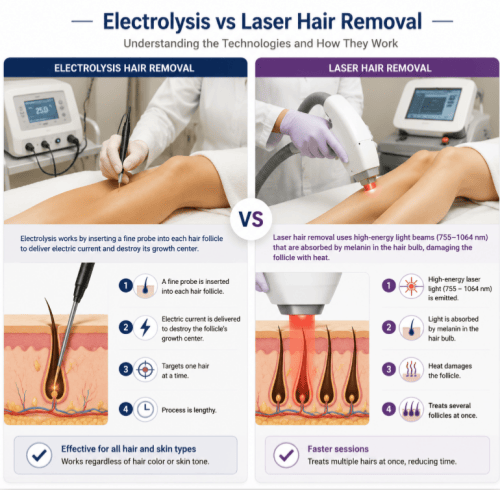
Unwanted hair management is one of the most enduring consumer problems in aesthetics, and long-term methods usually come down to two technologies: laser hair removal and IPL (Intense Pulsed Light).
Even though both rely on light energy aimed at the hair follicles, these two approaches significantly differ from each other in terms of optical principles, efficiency, safety and, what is even more important, commercial benefits.
If you are still asking yourself which one wins, here is the answer: professional laser hair removal is a better way to go because of its superior efficiency, accuracy and client satisfaction. The decision between the two technologies is not only based on treatment outcomes but also on how it affects the price you charge for your services, return on investment from your equipment and retention rate of your clients.
This guide helps you understand the key differences between the two techniques: from treatment procedures and side effects to procurement options of affordable and advanced devices.
1. Difference of technologies between Broad Spectrum and Single Wavelength
1.1 Scientific Difference between IPL and Laser
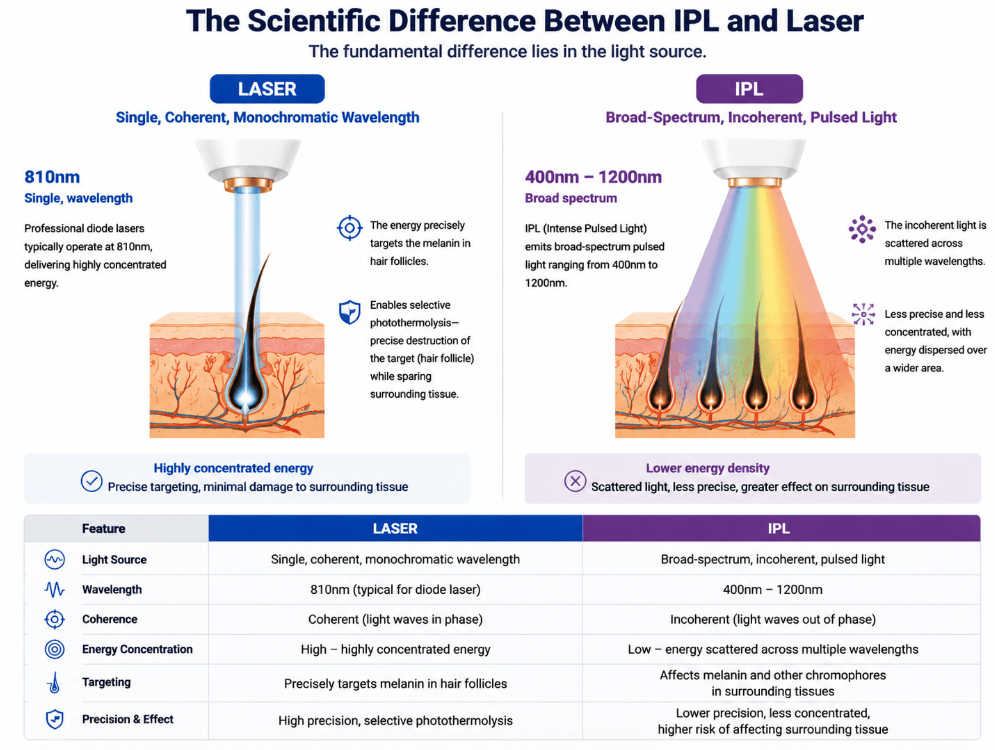
The basic difference of IPL and laser hair removal technologies is the light source.
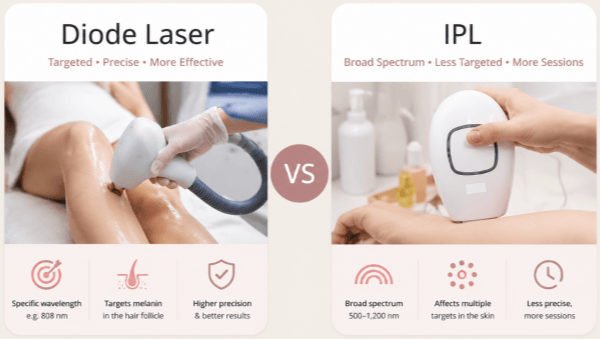
While the laser hair removal procedure involves a coherent monochromatic beam of light, IPL (Intense Pulsed Light) delivers incoherent light consisting of multiple wavelengths between 400nm and 1200nm.
1.2 Impact on Procedure Precision
In laser treatment, single wavelength feature allows focusing the energy on a particular target—in this case melanin in hair follicle—and causing minimal thermal damage to adjacent tissue. 810nm wavelength of professional diode lasers is selectively absorbed by melanin in hair bulbs.
IPL causes dispersion of energy; light is being absorbed not only by hair follicles but by the epidermis, blood vessels and adjacent pigmented tissues as well. This leads to lower energy density and penetration depth of IPL treatment, hence more difficult destruction of deeper hair follicles. As industry experts point out: "The broad-spectrum capability of IPL allows treating pigmentation and veins, but this versatility comes at the expense of diluted efficacy for hair removal".
1.3 Adaptability to Skin Type and Hair Color
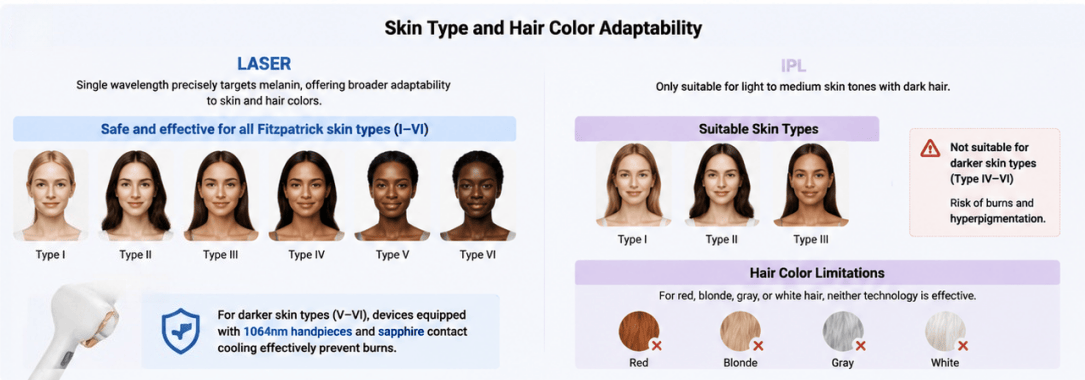
As laser uses a single wavelength and focuses on melanin, this technology shows greater adaptability to skin and hair color (including darker skin). Modern diode laser equipment can be used on all Fitzpatrick skin types (I-VI). Darker skin (types V-VI) can be effectively treated by laser devices with 1064nm handpiece and sapphire contact cooling to prevent burning.
IPL can be used only for light to medium skin type with dark hair. Treatment of darker skin with IPL is associated with high risk of burning and hyperpigmentation. Red, blonde, gray and white hair cannot be effectively treated using either IPL or laser technologies.
1.4 Clinical efficacy data
Several studies have demonstrated the clinical advantage of laser technology. One such study (2025) compared triple wavelength diode laser (755nm, 808nm, 1064nm) with IPL. Results showed that 36.7% of laser treated patients achieved good or excellent hair reduction at 2 month mark, while no IPL patient reached this level of treatment success. After four procedures, 39.7% of laser treated patients achieved excellent results against only 20.0% of IPL patients.
| Clinical Metric | Professional Laser | IPL |
| Long-term hair reduction (1 year) | 46% | 27% |
| Mean hair count reduction | 49.90% | 39.16% |
| Reduction at 3 months (diode vs IPL) | 59.7% | 42.4% |
| Reduction at 12 months | 69.2% | 52.7% |
| Patients with "excellent" results after 4 sessions | 39.7% | 20.0% |
Patients with "excellent" results after 4 sessions 39.7% 20.0%
Also, it was established that after 6 procedures diode laser achieved hair reduction of 78.13%, while IPL produced 56.23% of hair reduction.
Moreover, there are data suggesting that IPL could interfere with subsequent diode laser hair removal. Non-coherent IPL light weakens hair and decreases melanin absorpti
Treatment Cycles and Client Comfort Analysis
Treatment Sessions and Intervals Comparison
Laser hair removal requires 4-6 sessions, which are performed with intervals 4-8 weeks apart. For face areas, treatment interval is 4-6 weeks, and for body areas (legs, armpits, etc.) - 6-8 weeks. Full course lasts about 3-5 months. Some companies recommend 6-8 sessions to get the best result.
IPL hair removal requires 6-12 sessions and intervals 4-6 weeks apart. Home-use devices recommend 1 weekly session during the initial 4-12-week period. IPL procedure for professional use requires 3-12 sessions, performed with 1 month interval between them. Full course lasts about 3-6 months.
The main core of difference is that Laser technology provides better destruction efficiency per single session, thus, requires fewer overall treatment sessions. IPL, with its distributed energy, requires more treatment sessions to provide comparable results.
| Parameter | Laser | IPL |
| Total sessions needed | 4 – 6 | 6 – 12 |
| Treatment interval (initial) | 4 – 8 weeks (face: 4–6 wks; body: 6–8 wks) | 4 – 6 weeks (professional); weekly for home-use devices |
| Full course duration | 3 – 5 months | 3 – 6 months |
Client Comfort and Pain Feelings
In terms of client pain feeling, there are some important differences between these two techniques:
IPL is considered to be less painful because of low-intensity light energy. People describe IPL as warm feeling or rubber band snap. Low-energy IPL devices are almost painless.
Laser hair removal is considered to be a bit more painful but still in the tolerable range. People describe it as rubber band snap. In one of the studies, the average pain scores were 2/4 (mild discomfort) for laser. Scores of diode laser (808-810 nm) and alexandrite laser (755 nm) were 2.0 and 2.3 correspondingly.
It should be noted that during clinical comparisons it was found out that although the diode laser is more effective, it is also more painful; however, IPL, although being less painful, showed higher rates of redness, burning and edema. It means that being "painless" does not equal being "side effect free" – IPL's broad spectrum energy distributes into epidermis, provoking skin reaction.
| Parameter | Laser | IPL |
| Pain level | Moderate (rubber band snap) | Low to moderate (warmth, mild snap) |
| Typical pain score | ~2.0 – 2.3 (out of 4) | Lower than laser |
| Pain characteristics | Sharper but transient | Milder, often described as warm |
| Key insight | More effective but more painful | Less painful but higher skin reaction risk |
Side Effects Comparison
The most common side effects from laser include:
- Temporary redness (1-3 days);
- Perifollicular edema.
- Permanent side effects are very rare.
- Modern laser devices are provided with advanced cooling systems (sapphire contact cooling, air cooling, etc.) that make procedure more comfortable for client.
The most common side effects from IPL include:
- Clinical studies have found that the IPL group had significantly more cases of redness, pain and burning compared with the laser group.
- About 20% of clients experience erythema, peeling or burning/itching sensations.
- As IPL broad spectrum light energy is distributed in epidermis, the risk for clients with dark skin is much higher.
| Side Effect Aspect | Laser | IPL |
| Common reactions | Temporary redness, perifollicular edema | Redness, pain, burning, erythema, peeling |
| Duration | 1–3 days | May persist longer |
| Permanent side effects | Rare | Uncommon but possible (pigmentation changes) |
| Skin type risk | Safe for all Fitzpatrick types (I–VI) with proper settings | Higher risk for darker skin (III–VI) due to epidermal absorption |
| Cooling systems | Typically built in (sapphire, cryogen, etc.) | Optional, not always present |
Client Experience Summary
| Dimension | Laser | IPL |
| Number of sessions | 4 – 6 | 6 – 12 |
| Interval between sessions | 4 – 8 weeks | 4 – 6 weeks |
| Pain sensation | Moderate (rubber band snap) | Low to moderate (warmth) |
| Side effect risk | Lower (temporary redness) | Higher (redness, burning, pigmentation) |
| Cooling system | Usually equipped with advanced cooling | Partially equipped |
| Skin type adaptability | Fitzpatrick I – VI | Only light to medium skin tones |
Purchasing Strategies: Entry-Level Salons vs. High-End Clinics
Comparing Device Cost
| Device Type | Price Range | Best For |
| Entry-Level Professional IPL | $300 – $1,500 | Startup or small salons |
| Mid-Range Professional IPL | $2,000 – $15,000 | Small to medium-sized beauty salons |
| Entry-Level Diode Laser | $3,000 – $8,000 | Small professional clinics |
| Mid-Range Diode Laser | $15,000 – $30,000 | Medium-sized aesthetic clinics |
| High-End Diode Laser | $35,000 – $80,000+ | Large medspas / medical clinics |
| Premium Alexandrite / Ice Laser | $80,000 – $150,000+ | High-end medical-grade clinics |
Further Information about Investments:
- The payback time for lasers ranges from 6 to 12 months.
- Diode laser handpieces usually withstand 500,000 to 1,000,000 shots.
- Lifespan of the host device ranges from 8 to 12 years.
- Maintenance expenses amount to 5-10 percent of the initial cost.
Entry-Level Salons and Startups: Why IPL Makes Sense
Ideal Business Characteristics:
| Characteristic | Description |
| Budget | Limited (under $3,000) |
| Service focus | Basic hair removal, with some skin care services |
| Client base | Predominantly light to medium skin tones |
| Staff experience | Entry-level technicians with limited training |
| Market entry | Testing the hair removal market with low risk |
Advantages of IPL:
| Advantage | Benefit |
| Low initial investment | Minimal financial pressure, easy entry |
| Simple operation | Lower training costs, faster staff onboarding |
| Multi-functionality | One device handles hair removal, skin rejuvenation, and pigmentation treatment |
| Versatile platform | Serves as an "entry-level or multi-purpose platform" |
Risks to Consider:
| Risk | Impact |
| Lower efficacy | Client satisfaction may be below expectations |
| Skin type limitations | Cannot serve darker skin clients—limits market reach |
| More treatment sessions | Consumes more room time and staff hours |
| Client attrition | Clients may switch to competitors offering better results over time |
High-End Clinics and Medspas: The Case for Professional Laser
Ideal Business Characteristics:
| Characteristic | Description |
| Budget | Sufficient ($15,000+) |
| Brand positioning | Professional medspa / dermatology clinic |
| Client base | Diverse (including darker skin types) |
| Clinical priority | Maximum efficacy and client satisfaction |
| Brand goal | Establishing a premium, professional image |
Advantages of Laser:
| Advantage | Business Impact |
| Significantly superior efficacy | Higher hair reduction rates and more durable results |
| Universal skin compatibility | Suitable for all Fitzpatrick skin types (I–VI) |
| Fewer sessions | Clients complete treatment faster, improving convenience |
| Higher satisfaction | Drives positive word-of-mouth and referrals |
| Premium pricing | Enables higher per-client revenue |
| Professional differentiation | Establishes credibility vs. basic beauty salons |
Essential Features of Modern Diode Laser Systems:
| Feature | Purpose |
| Triple-wavelength system (755nm / 808nm / 1064nm) | Optimizes efficacy across all skin types and hair colors |
| Sapphire contact cooling | Protects epidermis, enhances comfort, reduces side effects |
| Dual-channel skin temperature monitoring | Ensures safety during treatment |
| FDA or CE-MDR certification | Validates clinical safety and compliance |
Hybrid Approach: Offering Both Technologies
For medium to large-sized clinics, offering both IPL and laser can be a strategic advantage:
| Device | Positioning | Target Clients |
| IPL | Entry-level hair removal, skin care packages | Budget-conscious clients |
| Laser | Professional permanent hair reduction | Premium clients, darker skin types |
Strategic Value:
- Gets all clients from various price ranges
- Facilitates up-selling of IPL clients into higher priced laser procedures
- Increases efficiency in terms of machine usage and revenue per square footage
A Critical Note:
Starting a client on IPL treatment and then transferring them to laser treatment is not advised. IPL makes the hair thinner, making the hair less likely to absorb melanin needed for the laser treatment.
Procurement Decision Checklist
| Question | IPL | Laser |
| What is your budget? | Under $3,000 | $15,000+ |
| What skin types do your clients have? | Light to medium only | All Fitzpatrick types (I–VI), including dark skin |
| What is your brand positioning? | Basic beauty / wellness | Professional medspa / medical aesthetics |
| What is your staff skill level? | Entry-level technicians | Certified / trained professionals |
| What are your revenue goals? | Lower per-client revenue, higher volume | Higher per-client revenue, premium loyalty |
| Do you need multi-functionality? | Yes—IPL handles rejuvenation, pigmentation, and hair removal | Laser focuses on hair removal but delivers superior results |
Summary Comparison Table
| Dimension | IPL | Professional Laser |
| Technology | Broad spectrum (400–1200nm), incoherent light | Single wavelength (e.g., 810nm), coherent light |
| Precision | Low—energy disperses | High—energy concentrates on the follicle |
| Skin type adaptability | Light to medium skin only | All Fitzpatrick skin types (I–VI) |
| Treatment sessions | 6 – 12 | 4 – 6 |
| Long-term hair reduction | ~27% | ~46% |
| Side effect risk | Higher (redness, burning, pigmentation) | Lower |
| Equipment cost | $300 – $15,000 | $3,000 – $80,000+ |
| Best suited for | Entry-level salons, startups | High-end clinics, medspas |
Recommendation
In case your salon is a professional medical aesthetic clinic with adequate budget, catering to different skin types including dark-skinned people, then the choice is obvious—a diode laser is undoubtedly the best option as far as efficiency, safety, skin compatibility, and value of the brand are concerned.
Should your salon be at an early stage of development, have minimal budget, and cater mainly to light-to-medium skin people, then IPL is the safest bet. But you should have a clear idea about its limitations in terms of efficiency and a plan for future transition to laser technology.
Conclusion
There can be no “one size fits all” solution to the question “IPL vs. Laser Hair Removal,” but there surely can be a “perfect fit” that is right for your particular business model.
In summary, knowing the difference between IPL and laser hair removal gives you the ability to match your financial investment to your clinical success. Regardless of whether you go with the flexibility of IPL technology or the power of lasers, the need for hair reduction is ever increasing. Get the correct equipment for your salon, educate your employees, and get yourself a slice of the lucrative market.
Frequently Asked Questions--IPL vs Laser Hair Removal
Q1: What is IPL laser hair removal?
Intense Pulsed Light uses several light wavelengths to reach melanin contained in hair follicles, progressively disabling them during the whole course of treatment. Though commonly called so, IPL is not a laser in fact.
Q2: What is the difference between IPL and laser hair removal?
The major difference between IPL and laser hair removal lies in light source used for both procedures—while IPL utilizes several light wavelengths, laser uses one single wavelength.
Q3: How often can I use IPL laser hair removal?
IPL sessions are usually performed once in 2 weeks during first 4-6 sessions, after that monthly follow-ups are required.
Q4: Is IPL laser hair removal safer than laser?
Since IPL uses light waves of lower intensity, the chances of burnout are lower, however, efficiency is limited too. According to clinical studies, side effects of IPL laser hair removal such as redness, pain, and burnings are more frequent compared to professional laser treatment.
Q5: Which technology gives better results?
As far as clinical studies go, laser provides better results than IPL when it comes to hair reduction.
Q6: Can I use IPL laser hair removal device on all skin types?
No. IPL works well for light to medium skin tones with dark hair only.
Diode Laser Hair Removal vs IPL: A Clinical & Commercial Comparison for Aesthetic Clinics
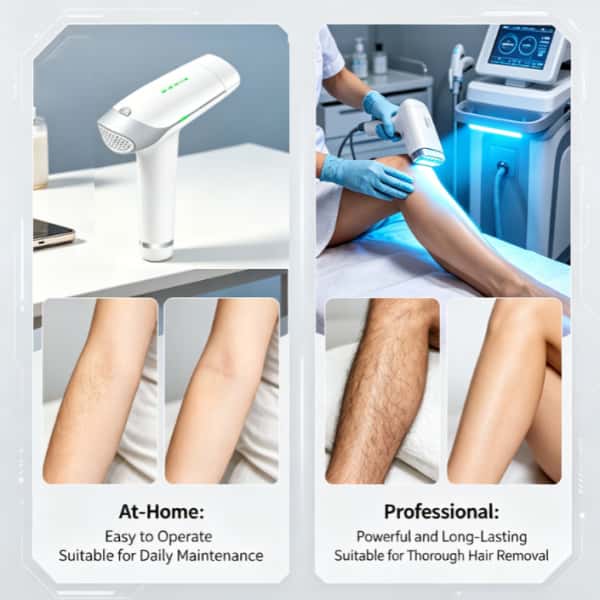
At-Home Laser Hair Removal vs Professional: Which Delivers Superior Results for Your Beauty Business?
Related Article