Electrolysis vs Laser Hair Removal: Which Equipment Should You Invest In?
Introduction
In case you own an aesthetic clinic or sell beauty tools, one of the most important questions you need to answer is which option to choose, electrolysis or laser hair removal.
Both methods can give you the result, yet there are many differences between electrolysis and laser hair removal that are not only medical, but also business. So, is electrolysis equal to laser hair removal? Of course, no! And understanding why matters a lot for your business success.
Below we will compare laser hair removal vs electrolysis from a commercial point of view, helping you to determine which method should be used for your clients, whether it is electrolysis or laser hair removal.
Understanding the Technologies: Working Principle of Electrolysis and Laser Hair Removal
In order to compare electrolysis hair removal vs laser, it is important to first explain how both methods work.
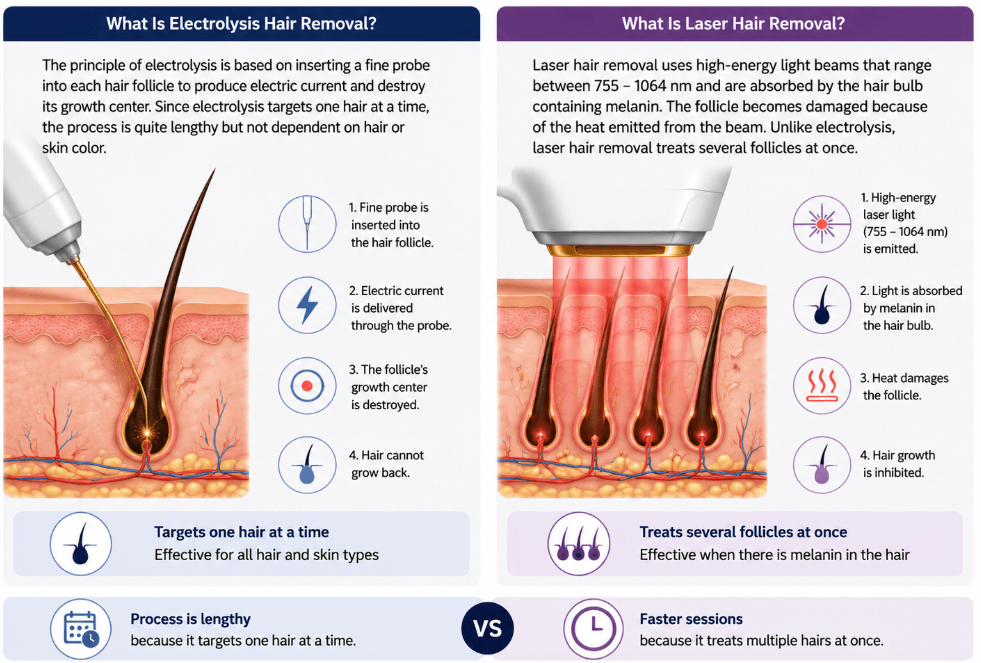
What Is Electrolysis Hair Removal?
The principle of electrolysis is based on inserting a fine probe into each hair follicle to produce electric current and destroy its growth center. Since electrolysis targets one hair at a time, the process is quite lengthy but not dependent on hair or skin color.
What Is Laser Hair Removal?
Laser hair removal uses high-energy light beams that range between 755 – 1064 nm and are absorbed by the hair bulb containing melanin. The follicle becomes damaged because of the heat emitted from the beam. Unlike electrolysis, laser hair removal treats several follicles at once.
Clinical Benefits and Side Effects: What to Tell Your Clients
For clinics and distributors of equipment, knowledge of the practical advantages and disadvantages of each technology is important not only for promotion purposes but also to prevent customer dissatisfaction and complaints.
Electrolysis – Benefits and Side Effects
✅ Key Benefits
- The only method approved for the permanent hair removal – Electrolysis is the only method that is approved by the FDA for permanent destruction of hair. Once the follicle is destroyed, hair will not grow anymore.
- Doesn’t require any maintenance – No touch-up procedures will be necessary after finishing the whole procedure.
- Universal method – Because it does not depend on the presence of melanin, this method works for all hair colors (including blonde, white, red, and gray hair) and all skin types (from I to VI).
- Suitable for any body area – This method is applicable for any part of the body and face, including eyebrows and bikini line areas.
⚠️ Potential Side Effects & Risks
- Pain – This procedure is rather painful with a stinging and pricking feeling experienced each time when the probe touches the skin.
- Temporary skin reaction – Redness, swelling, and irritation appear immediately after the procedure but usually disappear after several hours.
- Infection – If performed improperly, there is a possibility of infection or even scarring. The proper training of the operator is vital.
- Pigmentation change – Sometimes, the appearance of permanent or temporary pigmentation change occurs.
- Long procedure time – On average, 12-18 months are required to get rid of the hair completely with the expenses reaching $10,000 for large body parts.
Laser Hair Removal – Benefits and Side Effects
✅ Key Benefits
- Efficient – The laser energy works for several follicles at once. That makes this method perfect for larger body parts like legs, back, arms, and chest. Procedure time usually takes from 5 to 45 minutes.
- Effective hair reduction – Although not being permanent, this procedure leads to 70-90% long-term hair reduction with regrowing hairs becoming thinner, lighter, and slower.
- No downtime – There are no limitations on the activities after the procedure, and patients can resume normal lifestyle right after it.
- Comfortable – Most of the patients report moderate discomfort similar to the feeling of the rubber band hitting the skin. Also, most of the machines have built-in cooling systems.
⚠️ Potential Side Effects & Risks
- Skin irritation – Redness, swelling, and mild irritation of the skin appear temporarily but resolve in several hours to a few days.
- Pigmentation change – Skin lightening or darkening may happen. The increased risk is associated with the usage of improper wavelength on darker skin types (Fitzpatrick IV-VI).
- Blistering, crusting, scarring, or textural changes – These complications are quite rare but may happen sometimes, especially with inexperienced operators.
- Hypertrichosis paradoxical – Rare complication which includes thickening and darkening of surrounding hair (most likely during the facial treatment for some ethnicities).
- Eye injury – It is absolutely prohibited to perform laser hair removal procedure in the areas close to the eyes. Eye damage is very possible and is irreversible.
Permanence vs Speed of Treatment: A Direct Comparison
This is where the difference between the electrolysis and laser hair removal is revealed in full measure.
FDA Approval: Permanent Hair Removal vs. Permanent Hair Reduction
Electrolysis is the only FDA-approved hair removal procedure that guarantees complete removal of follicles and thus hair growth in future.
On the contrary, laser hair removal is FDA-cleared for "permanent hair reduction." The definition of permanent hair reduction implies long-term and stable reduction in the amount of hair regrowing after the treatment regime. Although the reduction is up to 85%-90% in the long run, but the hair will still be growing to some extent.
Can you compare electrolysis to laser hair removal? No way. The former is permanent follicle destruction, and the latter is permanent hair reduction.
Time Spent on Treatment During Sessions
Speed of treatment has direct effect on the number of patients served during the day and, consequently, on profit.
As it is shown by the clinical researches, electrolysis sessions take 152 minutes, whereas laser takes an average of 26 minutes per session. This is not a small difference but almost six times more efficient laser procedure.
Think about how much time you spend in each procedure:
- Electrolysis: 1-2 hours per session
- Laser hair removal: 5-45 minutes per session
The Whole Course of Treatment
The time gap goes even wider when you talk about treatment courses:
- Electrolysis: Takes 10-15+ sessions over 12-18 months
- Laser hair removal: Takes 6-8 sessions within approximately one year
Can you say that laser hair removal equals electrolysis in terms of effectiveness? Certainly not. Laser is much more effective in treatment delivery and, therefore, brings you more clients and profit.
Operating Costs and Consumables: The Truth About Profitability
In choosing electrolysis vs. laser hair removal for your clinic, costs are an essential factor to consider.
Cost of Acquisition
Cost of laser hair removal machines:
Basic professional diode hair removal platforms: $25,000-$40,000
Modern professional diode hair removal machines: $30,000-$100,000
Advanced machines: $120,000-$150,000+
Refurbished/lower end used systems: $20,000-$60,000
Cost of electrolysis machines:
Professional electrolysis equipment: usually $500-$5,000 for professional electrolysis handpieces
Higher-end brands such as Apilus electrolysis equipment: pricier but still much cheaper than lasers
Though electrolysis machines have a lower initial price tag, the total cost of ownership paints a different picture.
Cost of Consumables per Procedure
Unrivaled consumption efficiency of laser hair removal treatment:
- Latest generation diode lasers provide zero cost for consumables: no flashlamps, no gels needed
- Cost of consumables per procedure is about $0.0002-$0.0005
- Cost of your electricity per procedure
Costs of electrolysis procedure include:
- Disposable probes/needles must be changed for each follicle
- Supplies needed: sterilizing agents, gloves, topical anesthetics
- Costs are directly proportional to the number of clients you see and sessions they undergo
Cost of One Hair Removal Treatment to a Client
Apart from determining your pricing strategy, it also impacts how easy it is for you to acquire and retain your clients.
In one clinical study, the average cost of procedures was determined to be $5,161 for electrolysis vs. $981 for laser hair removal (a statistically significant difference with p < 0.01).
Per-procedure cost of electrolysis: $35-$52 per half hour
Laser hair removal procedure: usually $100-$250 per session
Laser is a more economical option for the client even with high costs for each procedure. The clinic makes money from high payments for each procedure with much lower labor expenses per minute.
Skin Type and Hair Color Suitability: Who Can You Treat?
Here electrolysis wins hands down, because whether it's better to use a facial hair removal laser or electrolysis depends on the particularities of your client.
Laser Hair Removal and Fitzpatrick Skin Types
Laser hair removal works by contrast in pigmentation between the hair and the skin. Therefore, its restrictions are:
Ideal clients:
Fair skin (Fitzpatrick I-II) + dark coarse hair
Difficult clients:
Asian skin (Fitzpatrick III-V) – high amount of melanin in the skin means greater risks of developing post-inflammatory hyperpigmentation (PIH)
However, diode and Nd:YAG lasers proved to be safe and effective for darker skin types:
Fitzpatrick IV-VI – 808nm diode lasers are safe and effective for Fitzpatrick types if used with proper settings
Undesirable clients:
Light, blonde, red, white and gray hair – laser is ineffective against such hair due to lack of melanin
Electrolysis: The Answer for Everybody
Electrolysis is suitable for all hair colors and skin types. Since this method doesn't depend on the pigment, it can successfully treat:
Blonde, red, gray and white hair
Fine vellus hair ("peach fuzz")
All Fitzpatrick skin types I-VI
Thus, electrolysis covers the range that laser cannot cover.
Market Growth and Commercial Scalability
For those who plan the future expansion of their business, market dynamics are mandatory.
The Laser Hair Removal Market - A Driver for Growth
According to Statista, the laser hair removal market was worth approximately $1.5 billion in 2025 and is expected to grow at a 14.7% CAGR to reach almost $5.8 billion by 2035. North America has ~41% of revenues, while the Asia-Pacific region grows rapidly at a CAGR of 16.5%.
Key point: Laser hair removal is an actively developing market. High demand among customers, fast treatment procedures, and "painless" technology drive the continuous market growth.
The Electrolysis Hair Removal Market - Stable and Niche
According to Statista, the global electrolysis hair removal market was estimated at $848 million in 2024 and is forecast to grow at a moderate 5.2% CAGR to $1.33 billion by 2033.
Key point: Electrolysis hair removal is a stable niche market that works well with loyal customers (PCOS patients, trans individuals, those with light hair) but does not have a huge growth potential like laser hair removal.
How Will These Factors Impact Your Investment?
| Factor | Electrolysis | Laser Hair Removal |
| Market size | $0.85B (2024) | $1.5B (2025) |
| Projected CAGR | 5.2% | 14.7% |
| Client pool | Niche (light hair, dark skin) | Mass market (dark hair, light skin) |
| Scalability | Limited by operator time | High (fast sessions, high throughput) |
Conclusion: Making Your Equipment Investment Decision
So, electrolysis vs laser hair removal — which equipment should you invest in?
The laser hair removal machine is the source of income, and the electrolysis is the tool of perfection.
In order to be a successful business owner or distributor interested in expanding and earning good money, there is a clear formula for you:
Start with laser hair removal machines – use the professional laser or multilaser and you will receive fast client turnover, increased profitability, and the payback period of 6-12 months. You will attract the mass market and earn each day.
Supplement with electrolysis – use it to attract those clients that cannot be properly treated by means of the laser hair removal machines (clients with light hair, dark skin, and hormonal facial hair), and provide additional "permanent finishing" services to those clients, who want 100% clearance.
In conclusion: do not make the choice between two types of hair removal machines – do it the other way around and invest in both.
FAQS--Electrolysis vs Laser Hair Removal
1、Is laser hair removal the same as electrolysis?
No. Laser works by targeting melanin in the hair follicle to work quickly in a large area, making it suitable for dark hair. Electrolysis does not target melanin, so it can be used on any type of hair and skin but is very slow.
2、Which one is more suitable for removal of facial hair: laser or electrolysis?
Laser is quicker and cheaper if you have dark hair and light-colored skin. Electrolysis is more suitable for blonde, red or gray hair, dark skin, or if your client has hormonal facial hair, and gives permanent results.
3、Which one is more expensive – electrolysis or laser hair removal?
For the client, the price of electrolysis will be higher (~$5,000 compared to $1,000 for laser hair removal). For the clinic, laser is more expensive in terms of investment costs but has better revenue per day.
4、Which procedure hurts more: electrolysis or laser?
Electrolysis causes a stinging sensation, whereas laser feels like a snap from a rubber band. Also, laser machines often come with a built-in cooling mechanism.
5、Do I need to offer both electrolysis and laser hair removal in my clinic?
In theory, yes. Start by using laser treatment for a quick return on investment and then add electrolysis for niche customers (blonde hair, dark skin, PCOS)
Diode Laser Hair Removal vs IPL: A Clinical & Commercial Comparison for Aesthetic Clinics
Related Article