The Professional’s Guide to Laser Hair Removal: What Spas and Clinics Need to Know
Introduction
Laser hair removal is one of the top requested aesthetic treatments worldwide. And for spas and medical clinics, laser hair removal can mean an increase in revenues with the help of a professional laser hair removal system, improved customer loyalty and, finally, competitiveness on the market.
But providing laser hair removal services requires not just purchasing equipment. You have to be aware of the technology, the myths, strict clinical guidelines, and effective management strategies.
In this article, you'll find answers to the following questions – what is laser hair removal, what is laser treatment for hair removal, what kind of laser is used for hair removal, and what is the process of laser hair removal? Moreover, we will reveal some critical aspects of laser hair removal from a business angle. So let's begin.
What Is Laser Hair Removal? Definition & Working Principle
If you plan to launch a laser hair removal service in your clinic, the first thing you have to know is the definition of this procedure. So, what is laser hair removal in brief? This is a medical treatment based on light energy that destroys unwanted hair at its root level, providing a noticeable decrease in hair growth. While such methods as shaving or waxing remove the hair above the skin level, laser therapy affects the dermis, destroying the hair growth centers.
The Science of Selective Photothermolysis
The working principle of laser therapy is based on selective photothermolysis, which means the destruction of tissues through the conversion of light energy into heat energy, which causes the destruction of certain components of tissues. To understand what is laser hair removal treatment precisely, it is essential to remember that the procedure should affect the hair follicle and destroy its germinative parts in the bulb and bulge with thermal effect. Therefore, it is necessary to conduct laser therapy in the stage of hair growth when the follicle is filled with maximum melanin, which will absorb the light energy, and is still connected to the vascular supply system.
What Is Laser Hair Removal Targets?
The primary target for the laser therapy is melanin pigment, meaning that the contrast of hair and skin tone plays a significant role in laser treatment. As for the best results, hair removal should be performed on dark, thick hair located on light skin. However, modern lasers allow performing laser therapy safely on different skin types, which we will discuss further.
What Is Laser Hair Removal Achieving? From a medical perspective, laser hair removal provides permanent hair reduction, and the effectiveness usually reaches 70-90%. Most people have to continue their treatments once or twice a year. For B2B customers, it is crucial to establish correct expectations since you have to explain that complete removal is impossible.
What Type of Laser Is Used for Hair Removal? Diode, Alex, Nd:YAG
First of all, for any medical practice that aims at launching a laser hair removal service, it is crucial to purchase the equipment. Therefore, it is essential to learn what type of laser is used for hair removal in professional clinics now.
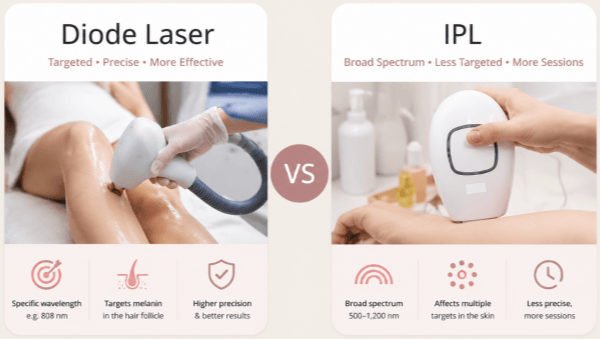
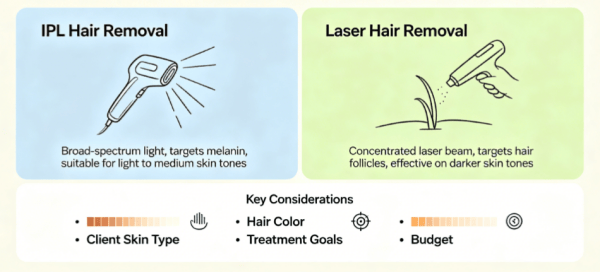
There are three main wavelengths – Diode (800-810 nm), Alexandrite (755 nm), and Nd:YAG (1064 nm).For clinics looking for versatile treatment solutions, a triple wavelength diode laser system can combine all three technologies in one platform. In addition, there is an Intense Pulsed Light, which is not considered the laser and is ineffective for hair removal. For professional treatment, you should purchase one or two lasers from this list.
Diode Laser -Reliable, Versatile Workhorse
Diode laser is the most popular and versatile wavelength used in modern diode laser hair removal machines. With wavelengths between 800 and 810 nm, this laser works effectively on light to medium skin tones (I-IV on Fitzpatrick scale). It is also the most common wavelength in medispas. Usually, it has a large spot size that allows to perform faster procedures in large areas such as legs and back. Due to built-in cooling systems, treatments are comfortable even if a patient has sensitive skin.
Alexandrite Laser -Fast Results for Light-Skin Clients
Alexandrite laser with a wavelength of 755 nm has the greatest absorption rate of melanin, making this laser the fastest one for light skin (types I-III on Fitzpatrick scale). At the same time, due to high melanin absorption, this laser poses the highest risk of burns when applied on tan skin. Therefore, Alexandrite laser is suitable only for treating mostly Caucasian clients.
Nd:YAG Laser -Safe for Dark Skin
Nd:Yag laser with wavelength of 1064 nm is the safest one for Fitzpatrick types IV-VI due to lower skin absorption. Although treatments can be slightly uncomfortable, they pose minimum epidermal damage. For multiethnic clinics, you should definitely purchase this laser.
What Is the Best Laser for Hair Removal?
The answer to this question is quite subjective since the best choice depends on clients' demographics. Nevertheless, in order to make an informed decision, we prepared a comparative table based on the most important features.
|
Laser Type |
Best Skin Type |
Speed |
Pain Level |
Equipment Cost |
Best For |
|
Alexandrite (755nm) |
Fitzpatrick I-III |
Very fast |
Medium |
$$$ |
High-volume clinics with light-skinned clientele |
|
Diode (800-810nm) |
Fitzpatrick I-IV |
Fast |
Low-Medium |
$$ |
General practice (most versatile) |
|
Nd:YAG (1064nm) |
Fitzpatrick IV-VI |
Medium |
Medium-High |
$$$ |
Clinics serving dark skin or multi-ethnic populations |
Thus, the best laser hair removal solution for most clinics is the diode laser platform with multiple wavelength support. In case you want to offer your services to a wide range of clients, you can also purchase the second laser from the list.
What Kind of Laser Is Used for Hair Removal in Clinical Practice?
From the perspective of a clinical practice, you will hear names of such brands as Candela GentleLase, Cynosure Elite, and Lumenis Lightsheer, but the technology is identical to Alexandrite, Diode, or Nd:Yag lasers described previously. When clients ask you what kind of laser is used for hair removal in your clinic, you should give an exact name of the technology together with a model number. Moreover, explain why this particular wavelength is perfect for them. Such approach will build your authority.
Additionally, what type of laser is used for hair removal for vellus or other fine hair? Unfortunately, it is impossible to perform hair reduction with laser devices in cases of non-pigmented hair. Such hair does not contain melanin. The best choice in this situation is electrolysis.
What Is the Process of Laser Hair Removal? Standard Clinic Workflow
In order to provide clients with high-quality services, it is crucial to standardize every step of laser hair removal, from the consultation to the post-procedure recommendations. We will describe the steps and help you to understand what is the process of laser hair removal for better results.
Step 1. Consultation and Patch Test
At the beginning of the course of treatments, clients undergo consultations where they have to inform a therapist of the following things: medical history (photosensitivity, autoimmune diseases, isotretinoin use, pregnancy); Fitzpatrick scale; and a patch test performed on a small part of the skin.
Step 2. Preparation Shaving
24 hours before the procedure is mandatory for most clients, but in case someone comes to you without shaving, you have to provide him/her with a disposable razor. Next, wash the skin with a non-alcoholic, mild cleanser. Never apply numbing creams on sensitive skin unless this is explicitly stated in the prescription.
Step 3. Settings and Safety Eyewear
Choose laser treatment settings depending on client's demographics. Remember that both a client and a therapist have to wear laser protection eyewear during the procedure. Make a test shot to determine the right parameters of the device, including skin response to the treatment (mild erythema and perifollicular edema is desired).
Step 4. Procedure Delivery
Using a systematic pattern, provide laser treatments with slight overlapping. It is important to maintain a consistent contact with the skin in case you have a contact-cooling system installed. Patients usually describe this sensation as warm pinpricks.
Step 5. Cooling and Post-Procedures
Immediately after you finish your work, apply the cooled aloe gel or use cold packs. You should advise your patients to follow the recommendations below: no sunlight for 2 days; apply sunscreen with SPF 30 and higher; no hot baths/shower for 24-48 hours; no physical exercises; no waxing or plucking between procedures.
Step 6. Appointment Bookings
Schedule the following procedure within 4-6 weeks. Advise patients to stick to the schedule, as this will bring them best results.
Quality Control Checklist for Clinics (Downloadable Version)
Here are some essential elements that clinics have to control daily.
- Client signed an informed consent
- Patch test was performed properly
- No contraindications (pregnancy, accutane, active infection)
- Laser settings were chosen in accordance with client's skin type
- Appropriate eye protection was used
- Cooling system is working
- Post-care instruction was given
- Next appointment was booked
By following the steps of laser hair removal thoroughly, your clinic will have high booking rates.
What Is Not True of Laser Hair Removal? Debunking 6 Persistent Myths
False information often circulates the web. Learning what is not true of laser hair removal is as critical for your practice as learning the truths. Here are some common myths that can negatively impact the credibility of your clinic.
Myth 1: Laser Hair Removal Is Pain-Free for Everyone
The first myth that can mislead potential clients is the idea that this therapy is entirely painless. Actually, the vast majority of clients feels the sensation that looks like warm pinpricks. What is not true of laser hair removal? It is painful? In spite of this fact, modern lasers with integrated cooling devices can minimize the pain substantially. Nevertheless, you have to avoid using the term 'pain-free'.
Myth 2: One Session Will Result in Complete Removal
It cannot be achieved within 1 session. In order to reach good results, it is necessary to have 6-8 sessions at least since only 15-20% of hair is in an active growth stage.
Myth 3: Laser Is Effective for Every Skin Type
This statement contradicts reality. Older laser devices had a higher risk of burns on dark skin. Nevertheless, modern devices are safe even for Fitzpatrick skin types IV-VI. Thus, Nd:Yag laser is a good choice for dark skin patients.
Myth 4: Laser Therapy Can Cause Infertility
It is impossible. The laser energy penetrates up to 4 mm only. As it cannot affect ovaries or testes, this therapy is perfectly safe. You can refer your clients to some websites and researches if necessary.
Myth 5: Shaving Is Unnecessary Before the Procedure
Shaving is not an optional action. In order to provide laser treatment without burns, it is necessary to shave 24 hours before the procedure, as otherwise, the laser will burn the hair shafts on the skin surface, not follicles.
Myth 6: Anyone Can Apply This Method after Watching a Video
It is not true! This myth can cost you lawsuits in case clients have adverse reactions. Only properly trained specialists can provide laser hair removal procedures legally in almost all states. What is not true of laser hair removal from a legal perspective? Improper operation of the equipment. By knowing what is not true of laser hair removal, you protect your business and prevent bad reviews.
Important Business & Safety Points for Spas & Clinics
Besides the clinical aspects of the work, there are some business and safety points that you should remember to create a successful clinic.
Choosing the Right Equipment – Beyond the Lasers
When choosing a laser device, you should take into account the following points.
Upfront cost vs. leasing – Typical prices: 40,000–40,000–150,000 per device. Leasing preserves cash flow.
Regulatory approval – Ensure FDA 510(k) clearance or CE mark.
Consumables – Some brands require expensive disposable tips or cooling cartridges.
Service & warranty – Ask about mean time between failures (MTBF) and local technician availability.
Training included – Manufacturer should provide initial certification.
Don't buy cheap laser devices, as they can result in adverse reactions and harm your reputation.
You can also compare different laser hair removal technologies before purchasing a device, we would recommend purchasing a professional laser hair removal system from Jingyue Beauty. Our devices work on the triple-wavelength technology (755/808/1064 nm), have certificates from ISO and CE. Check specifications of our devices on the product page.
Training Your Staff & Regulatory Requirements
First of all, it is important to know who can use lasers legally. Commonly allowed are physicians, physician assistants, nurses, and licensed aestheticians with additional laser certification.
Mandatory Requirements: laser safety officer (LSO) certification; annual equipment inspection; written laser safety procedures; and malpractice insurance.
Documentation: keep a record of each procedure with settings, patients ID, operator's name, and adverse events.
Adverse Events Management
Even when the procedure is done correctly, there are several possible side effects: Common side effects:Mild redness; swelling (1-72 hours) Usually, clients can calm down with cold packs.
Less Common side effects: blistering; crusting You can apply some antibacterial creams on affected areas.
Rare side effects: Hyperpigmentation; hypopigmentation Usually, this is temporary, but in order to prevent hyperpigmentation, patients should avoid sun exposure.
Absolute Contraindications Pregnant women; active skin infections; recent isotretinoin treatment; photosensitive medication; recent tanning procedures; tattooing in treatment area. Write a special protocol to manage emergencies, such as burns or allergies.
Price Strategy & Package Design for Increased Revenue
Laser hair removal therapy is similar to subscription service in terms of its business model, as it requires clients' loyalty to bring benefits for you. Here are some tips on laser hair removal pricing strategy:
Single Session
Price Should Be High. This motivates clients to buy a package of sessions. For instance, if you set the price of 1 session at $200, a client can buy a package of 6 sessions for $900. (This way, you will get $150 per session).
Package
Deals 6 or 8 prepaid sessions are great ways to lock clients for 6-9 months.
Membership Model
Monthly membership program for $49 includes one treatment on a small body part. It helps to stabilize cash flows.
Area-Based Pricing
Small: upper lip, chin; Medium: armpits, bikini; Large: lower legs, full arm; Extra-large: back, legs.
Upsell
Offer Numbing cream; after-laser gel; sunscreen as retail products. Never sell your services at low prices, since the number of clients will be very high. But they won't return to your clinic after completing treatment.
Final Recommendations for Clinics & Spas
Investing in training is a smart move, so you should have at least one laser practitioner. Purchase the right equipment to cover all skin types. Be transparent and honest when describing your services. Document everything. Stay updated and renew your laser safety certification once per year. Develop treatment packages and manage clients' expectations correctly.
Conclusion
By purchasing the right professional diode laser system and applying strict clinical procedures, you can establish a professional and profitable medical business. Moreover, the choice of a reliable equipment supplier will ensure high quality of results and positive testimonials.
FAQs – About Laser Hair Removal
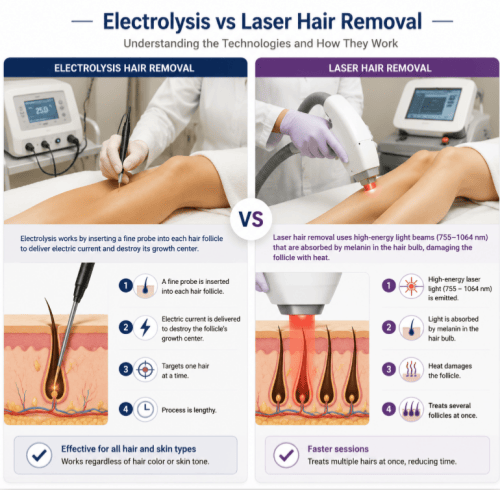
Q1: What is laser hair removal vs electrolysis?
Lasers target many hair follicles at once while electrolysis kills each follicle individually. In addition, the latter one is the only procedure FDA-certified for complete hair removal.
Q2: What is the best laser for hair removal on male backs?
Devices with diode and Nd:YAG lasers and large spot sizes (>12 mm). Men usually have thicker hair that needs higher fluences.
Q3: What kind of laser is used for hair removal on hormonal areas (chin, neck)?
Diode or alexandrite (light skin) and Nd:YAG (dark skin). Hormonal hair removal requires 8-12 procedures.
Q4: How much should a clinic charge per session?
Prices may vary, depending on your location. Average prices for US region: underarms $75-$150, legs $100-$150, back $200-$400, Brazilian $150-$300. Buying a package reduces the price per session.
Q5: How long does a laser machine last?
If you use high-quality device, you can expect it to work 5-10 year s with appropriate servicing. Diode lasers' diodes need to be replaced every 500,000 to 1 million pulses.
The Business Benefits of Diode Laser Hair Removal: Efficiency and Results
How to Use IPL Hair Removal at Home: Step‑by‑Step Guide
Related Article