What is a Q-Switched Laser?
An In-Depth Guide to Q-Switched Laser
In the world of lasers, where precision and power are paramount, few technologies are as impactful as the Q-switched laser. You may have heard of them in the context of tattoo removal or high-precision manufacturing, but what exactly are they, and how do they achieve their remarkable effects? At its core, a Q-switched laser is a type of laser specifically designed to produce an extremely intense, bright pulse of light that lasts for just a few billionths of a second (nanoseconds). Unlike continuous-wave lasers that emit a steady beam, or even long-pulsed lasers, the Q-switched laser stores a massive amount of energy and then releases it all at once in a single, powerful burst. This unique capability makes it indispensable across a wide range of fields, from medicine to industry. This comprehensive guide will delve into the principles, types, and revolutionary applications of this powerful technology.
1. How Does a Q-Switched Laser Work? The Principle of Q-Switching
To understand how a Q-switched laser works, a simple analogy is incredibly helpful. Imagine building a dam across a river.

-
The Dam is Closed (Low-Q State): You let the water (representing light energy) build up behind the dam for a long time. The reservoir fills to an immense capacity. In a laser cavity, this is the "energy storage" phase. The Q-switch is an optical device that acts like a dam, preventing light from bouncing between the mirrors and forming a laser beam. Meanwhile, the laser's pump source (like a flashlamp or diode) continues to excite atoms in the gain medium, creating a massive population inversion—a huge store of potential energy.
-
The Dam is Opened Instantly (High-Q State): Suddenly, you open the floodgates completely. The enormous volume of stored water is released in a catastrophic, powerful surge. In the laser, the Q-switch is rapidly switched to a transparent state, allowing the cavity to form. All the stored energy is then released in a single, gigantic pulse of light.
This process is formally known as Q-switching, where "Q" stands for the quality factor of the laser's optical resonator. A high Q-factor means the resonator has low losses and can sustain lasing action, while a low Q-factor means high losses, preventing lasing. By strategically switching the Q-factor from low to high, the Q-switched laser generates what are known as giant pulses.
2. Main Types of Q-Switches & Key Technologies
There are several methods to implement the Q-switching principle, each with its own advantages and ideal use cases. The two main categories are active and passive Q-switches.
✅Acousto-Optic Q-Switches (The Most Common)
An acousto-optic Q-switch uses sound waves to create a periodic grating in a crystal, like germanium or fused silica. When a high-frequency radio signal is applied to a transducer attached to the crystal, it generates sound waves.
-
How it works: These sound waves create a density variation in the crystal, which acts like a diffraction grating. When the RF signal is on, this grating deflects a portion of the laser light out of the cavity's alignment, introducing loss (low-Q state). When the RF signal is turned off, the grating disappears, the crystal becomes transparent, and the cavity losses drop to near zero (high-Q state), releasing the pulse.
-
Advantages: Highly reliable, can operate at high repetition rates (kHz), and is suitable for many continuous-wave pumped lasers like Nd:YAG.
-
Disadvantages: The switching speed is not as fast as electro-optic methods, and it requires a radio frequency driver.

✅Electro-Optic Q-Switches (The Fastest)
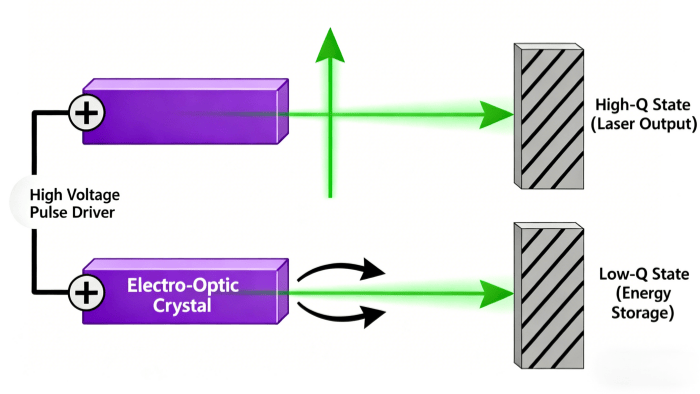
An electro-optic Q-switch uses an electro-optic crystal, such as Potassium Dideuterium Phosphate (KD*P) or Lithium Niobate, whose refractive index changes when an electric voltage is applied.
-
How it works: With no voltage, the crystal may allow light to pass. When a specific voltage (the "half-wave voltage") is applied, it rotates the polarization of the light. Combined with a polarizer inside the cavity, this effectively blocks the light path, creating a low-Q state. To release the pulse, the voltage is removed very quickly (in nanoseconds), allowing the light to pass through the polarizer and lase.
-
Advantages: Extremely fast switching times, leading to shorter pulse durations and higher peak powers. Ideal for low-repetition-rate, high-pulse-energy systems.
-
Disadvantages: Requires a very high-voltage pulse generator, is generally more expensive, and can be sensitive to temperature changes.
✅Passive Q-Switches (The Simpler Alternative)
A passive Q-switch does not require an external electrical signal. Instead, it uses a saturable absorber—a material that is opaque at low light intensities but becomes transparent when the light intensity reaches a certain threshold.
-
How it works: Initially, the saturable absorber (e.g., a crystal like Gr:YAG or a semiconductor saturable absorber mirror - SESAM) absorbs light, keeping the cavity in a low-Q state. As the population inversion builds up, the spontaneous emission eventually becomes intense enough to "bleach" the absorber, making it transparent almost instantly. This switches the cavity to a high-Q state, triggering the emission of a giant pulse.
-
Advantages: Very simple, compact, and cost-effective as it needs no driver electronics. Great for small, robust laser designs.
-
Disadvantages: Less control over the exact timing of the pulse, and the repetition rate is determined by the pump power and the absorber's recovery time.

3. The Defining Characteristics of Q-Switched Lasers
The unique operating principle of the Q-switched laser gives it a set of characteristics that distinguish it from all other laser types.
✅Extremely High Peak Power
This is the most significant feature. While the total energy in a pulse might be modest (e.g., in millijoules), because that energy is delivered in a few nanosecond pulses, the instantaneous power (Peak Power = Pulse Energy / Pulse Duration) is enormous. A typical Q-switched laser can easily achieve peak powers in the megawatt (MW) to gigawatt (GW) range, far exceeding any continuous-wave laser.
✅Nanosecond Pulse Durations
The pulses from a Q-switched laser are exceptionally short, typically in the range of 5 to 100 nanoseconds. This ultra-short duration is key to minimizing heat diffusion, enabling precise, clean interactions with materials.
✅The Photomechanical Effect (Photoacoustic)
This is the cornerstone of many medical and industrial applications. When these intense nanosecond pulses strike a material that strongly absorbs the laser wavelength, the energy is deposited so rapidly that it causes explosive thermal expansion. This creates a shockwave or an acoustic wave that mechanically fragments the target material. This is a fundamentally different interaction than the thermal melting or vaporization seen with longer-pulse lasers.
4. Core Benefits and Effectiveness of Q-Switched Lasers
The unique operating principle and characteristics of the Q-switched laser translate into a set of unparalleled benefits that solidify its status as a cornerstone technology in dermatology. Understanding these advantages explains why it remains the preferred choice for practitioners worldwide.
✅Unmatched Precision and Minimal Tissue Damage
-
Effectiveness: This precision directly translates to a markedly reduced risk of scarring. By preserving the healthy tissue around the target, the laser achieves its goal with exceptional cleanliness and safety, making it ideal for treating delicate areas and ensuring optimal cosmetic outcomes.
✅Superior Efficacy for Pigmented Lesions and Tattoos
Decades of clinical use have proven the Q-switched laser to be the gold-standard treatment for a wide array of pigmentation issues. Its effectiveness is unmatched in several key areas:
-
Tattoo Removal: The photomechanical effect is uniquely capable of breaking down the stable, complex molecules of tattoo inks. No other laser technology has a longer or more successful track record in safely and effectively removing tattoos of all colors.
-
Sun Spots, Age Spots, and Freckles: Treatment is remarkably effective, often requiring only one or two sessions. The targeted melanin absorbs the light, causing the lesion to darken and flake off within days, revealing clear skin underneath.
-
Melasma: While requiring expert technique, low-fluence treatment with a Q-switched Nd:YAG laser can effectively break up the stubborn melanin deposits responsible for melasma, offering a solution for cases resistant to topical therapies.
✅Enhanced Safety for Diverse Skin Types
This is a critical benefit in today's diverse patient populations. The Q-switched Nd:YAG laser operating at its 1064 nm wavelength is one of the safest laser options available for patients with darker skin tones (Fitzpatrick IV-VI).
-
Why it's Safe: The 1064 nm wavelength is poorly absorbed by the melanin in the epidermis (the skin's outer layer). This allows the laser energy to bypass the surface melanin safely and reach its intended target in the dermis (e.g., tattoo ink or deep pigment) without causing undue injury to the surrounding skin. This significantly lowers the risk of post-inflammatory hyperpigmentation (PIH) or hypopigmentation, which are common concerns with other laser types.
✅Minimal Downtime and Patient Comfort
Compared to ablative lasers that remove layers of skin, treatments with a Q-switched laser are minimally invasive, leading to a much more comfortable patient experience.
-
Procedure and Recovery: A treatment session is typically quick, with sensations often described as similar to the snap of a rubber band. Because the skin's surface remains largely intact, downtime is minimal. Patients may experience temporary redness and swelling, but they can usually return to normal activities immediately afterward. The development of "laser toning" protocols using very low fluences allows for a series of gentle treatments with absolutely no social downtime, making it an incredibly convenient option for skin rejuvenation.
5. Common Wavelengths and Types of Q-Switched Lasers
The effectiveness of a Q-switched laser in dermatology heavily depends on selecting the appropriate wavelength, which determines its penetration depth and the chromophore it targets most effectively. Different laser gain mediums produce different wavelengths, each with distinct advantages.

✅ Q-switched Nd:YAG Laser (1064 nm & 532 nm)
This is arguably the most versatile and widely used Q-switched laser in aesthetics.
-
1064 nm Wavelength: This near-infrared wavelength penetrates deeply into the skin. It is poorly absorbed by melanin compared to shorter wavelengths, making it the safest and most effective choice for treating darker skin types (Fitzpatrick IV-VI). It is the primary wavelength for treating dermal pigmentation and black, blue, and green tattoo inks. Its deep penetration also makes it useful for stimulating collagen.
-
532 nm Wavelength: By passing the 1064 nm beam through a frequency-doubling crystal, a 532 nm (green) wavelength is generated. This wavelength is highly absorbed by melanin and red pigments. It is exceptionally effective for treating superficial pigmented lesions (like sun spots) and red, orange, and yellow tattoo inks. However, its high melanin absorption also means it carries a higher risk of hypopigmentation and should be used with caution in darker skin.
✅ Q-switched Alexandrite Laser (755 nm)
This laser produces a red light at 755 nm, which is very well-absorbed by melanin. It is a highly effective modality for treating a variety of pigmented lesions and is considered one of the most effective lasers for removing blue, black, and green tattoo inks. However, due to its strong melanin absorption, it is generally recommended for use on lighter skin types (Fitzpatrick I-III) to minimize the risk of post-inflammatory hyperpigmentation.
✅ Q-switched Ruby Laser (694 nm)
As one of the earliest lasers used in dermatology, the Q-switched Ruby laser emits red light at 694 nm. It is highly absorbed by melanin and is effective for treating pigmented lesions and certain tattoo colors. However, it has largely been superseded by the Nd:YAG and Alexandrite lasers because it carries the highest risk of post-inflammatory hyperpigmentation, particularly in patients with darker skin tones. Its use is now mostly limited to specific, challenging cases under expert supervision.
Choosing the Right Laser:
The selection of a Q-switched Nd:YAG laser, Alexandrite, or Ruby laser depends on the specific condition being treated, the patient's skin type, and the colors of the tattoo ink. A skilled practitioner will choose the wavelength that maximizes efficacy for the target while minimizing risk to the surrounding skin.
6. Primary Applications of Q-Switch Lasers in Dermatology and Aesthetics
The unique combination of high peak power, short nanosecond pulses, and the dominant photomechanical effect makes the Q-switched laser an unparalleled tool in the field of dermatology and aesthetics. Its ability to precisely target microscopic structures within the skin without causing significant thermal damage to the surrounding tissue is the cornerstone of its success. This principle, known as selective photothermolysis, is masterfully executed by these lasers to treat a variety of skin concerns.
1). Tattoo Removal: The Gold Standard
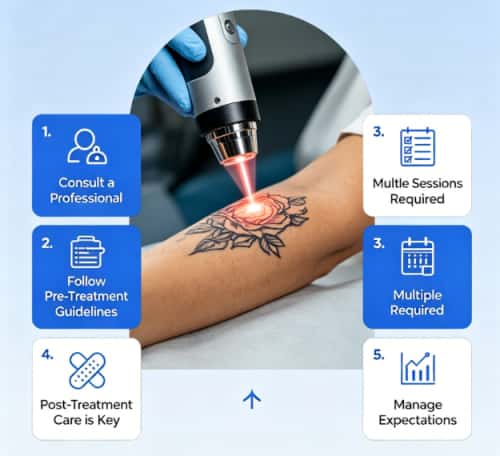
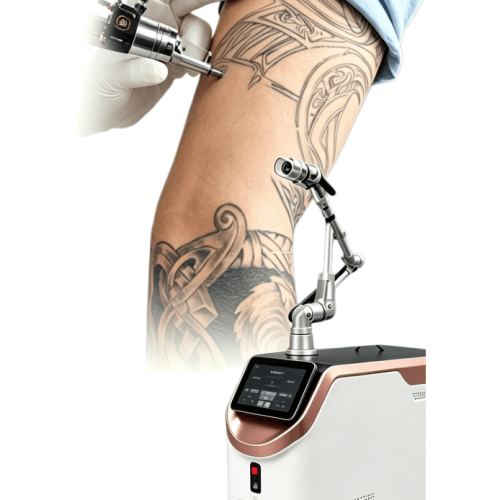
This is the most renowned application of Q-switched laser technology. Tattoo ink particles are too large for the body's immune system to remove naturally. The Q-switched laser addresses this by delivering intense nanosecond pulses that are absorbed by the ink particles. The rapid absorption of energy causes the particles to expand and fracture through a photomechanical effect, shattering them into tiny fragments. These smaller particles are then gradually engulfed and cleared away by the body's white blood cells over the following weeks and months.
The specific wavelength of the Q-switched laser can be selected to target different ink colors effectively, making it a versatile solution for multi-colored tattoos.

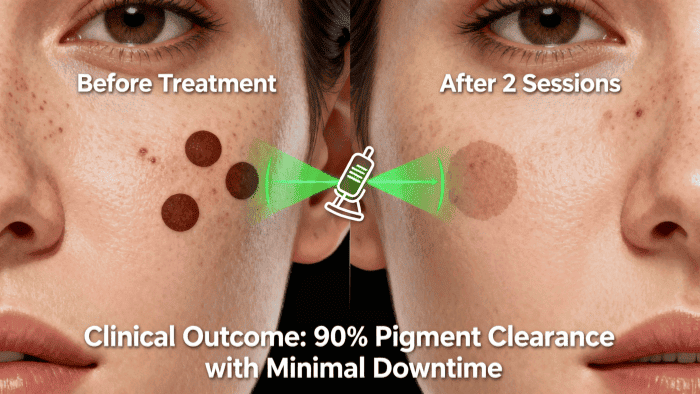
2). Treatment of Pigmented Lesions
The Q-switched laser is exceptionally effective at treating a wide range of benign pigmented lesions by targeting the natural chromophore, melanin.
-
Solar Lentigos (Sun Spots) and Ephelides (Freckles): The laser energy is absorbed by the concentrated melanin in these lesions, causing its mechanical destruction. The treated area typically darkens temporarily and flakes off after a few days, revealing clearer skin underneath.
-
Melasma: Treatment of melasma requires considerable expertise due to its complexity. While not a first-line treatment and carrying a risk of rebound pigmentation, Q-switched lasers, particularly at low fluences in a technique known as "laser toning," can be used to break up melanin clusters. The Q-switched Nd:YAG laser at its 1064 nm wavelength is often the preferred choice due to its deeper penetration and lower risk of post-inflammatory hyperpigmentation, especially in darker skin types.
3). Skin Rejuvenation and Laser Toning
Using very low fluences, the Q-switched laser can stimulate the skin without causing visible damage. The micro-injuries and photomechanical effect trigger the skin's wound healing response, leading to neocollagenesis (the formation of new collagen) and elastin production. This process results in improved skin texture, reduced pore size, and overall rejuvenation. This approach is particularly popular in certain Asian markets for brightening the complexion and treating melasma.

7. Q-Switched vs Picosecond Lasers: What's the Difference?
The natural evolution of the Q-switched laser is the picosecond laser, which generates pulses that are even shorter—picoseconds (trillionths of a second). This raises an important question: what is the difference?
-
Pulse Duration: This is the key differentiator. Q-switched lasers produce nanosecond pulses (10⁻⁹ seconds), while picosecond lasers produce pulses that are about 100 to 1000 times shorter (10⁻¹² seconds).
-
Mechanism of Action: Both rely on a photomechanical effect, but the shorter pulse of a picosecond laser creates a more intense stress confinement. This leads to more efficient fragmentation of particles with a smaller thermal footprint. It is often described as "shattering" the target, whereas a Q-switched laser "cracks" it.
-
Applications: Picosecond lasers are often considered more effective for difficult-to-treat tattoos (especially colors like blue and green) and for treating pigmentation and acne scars with fewer treatment sessions. However, Q-switched lasers remain the gold standard and a highly effective, more cost-efficient solution for the vast majority of tattoo removal and pigmentation cases.
In essence, picosecond lasers represent a refinement and advancement of the pulsed laser concept pioneered by Q-switching, pushing the boundaries of pulse duration and mechanical impact even further. More About Pico Laser vs Q-Switched Laser Differences.
Conclusion
The Q-switched laser is a masterpiece of laser engineering, a technology that masterfully controls light and energy to produce some of the most intense pulses of light achievable. From its clever use of the Q-factor to build and release giant pulses, to its implementation via acousto-optic, electro-optic, or passive modulators, its design is both elegant and powerful. The resulting nanosecond pulses with their high peak power and dominant photomechanical effect have unlocked possibilities that were once unimaginable, revolutionizing fields as diverse as cosmetic dermatology and advanced manufacturing. While newer technologies like the picosecond laser continue to emerge, the Q-switched laser remains a robust, versatile, and foundational tool, whose impact on science, medicine, and industry will be felt for decades to come.
Pico Laser vs Q-Switch Laser: Clinical Applications in Modern Aesthetic Practice
What Is The Best Laser For Tattoo Removal?
Related Article