What Is Fractional Laser
Definition : Fractional Laser What Is It
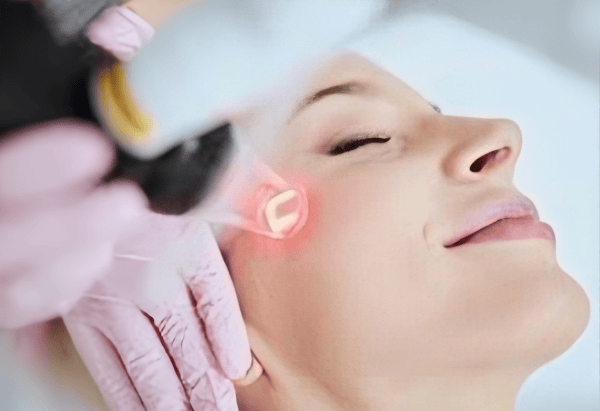
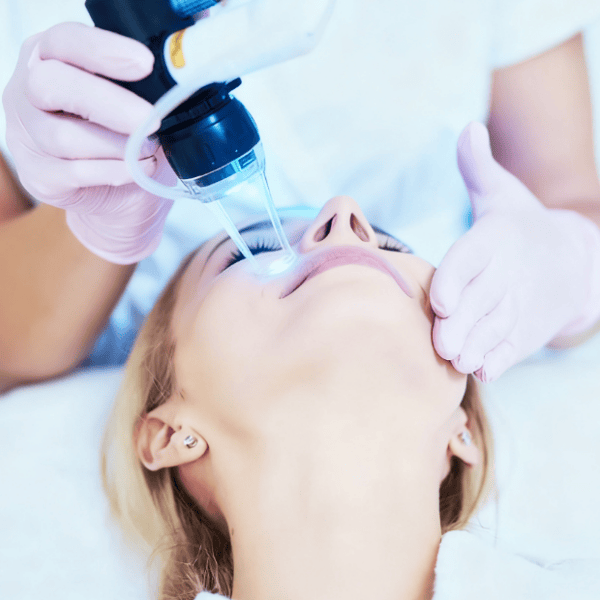
Fractional laser refers to a type of laser device where specific infrared wavelengths and power levels are focused and controlled via computer software. A pattern generator and scanning galvanometer work together to project the laser in a predetermined "fractional" or dot-like pattern onto the skin, delivering non-continuous irradiation to achieve therapeutic effects.
Its primary mechanism of action is based on "fractional photothermolysis and stimulated regeneration." This technology was designed to minimize adverse reactions, such as large-area skin burns, which were common with earlier laser treatments. It was developed in 2003 by Dr. Rox Anderson, Dr. Dieter Manstein, and their team, and is considered one of the "big three" devices in dermatological laser technology.
These systems primarily use infrared wavelengths that target water in the skin tissues, making the treatment less dependent on skin color. Fractional lasers fall under the category of micro-ablative to ablative treatments, characterized by thermal coagulation and vaporization effects.
Fractional Laser Machine typically operates in two primary modes: Fractional Mode and Normal Mode (Pulsed Mode). However, evolving market demands and technological advancements have led to the introduction of specialized features in certain fractional laser systems, such as a "Female Intimate Treatment Mode" designed specifically for gynecological applications.
Additionally, fractional lasers employ two main optical delivery methods for transmitting laser energy to the treatment area: Articulated Arm Delivery (A); Fiber Optic Delivery (F).
What Is Fractional Laser Applications and Various Wavelength Characteristics?
|
Applications |
Wavelength |
|
1.Skin resurfacing |
10600 nm, 2940 nm |
|
2.Ablation and cutting |
10600 nm, 2940 nm |
|
3.Skin rejuvenation and wrinkle reduction |
10600 nm, 2940 nm, 1927 nm, 1540 nm |
|
4.Acne treatment |
10600 nm, 1927 nm |
|
5.Inflammatory pigmentation treatment |
1927 nm (F), 1540 nm (F) |
|
6.Female intimate treatments |
10600 nm, 2940 nm |
|
Remarks: (A): Articulated arm output | (F): Fiber optic output |
|
Of all the laser types mentioned above, the wavelength with the peak water absorption is 2940 nm (A), and the most versatile laser is 10600 nm (A).
What Is Fractional Laser Classification: Ablative → Micro-Ablative → Non-Ablative
Based on the water absorption properties of different laser wavelengths, fractional lasers can be divided into two main categories:
1) Ablative Fractional Lasers:
2) Non-Ablative Fractional Lasers:
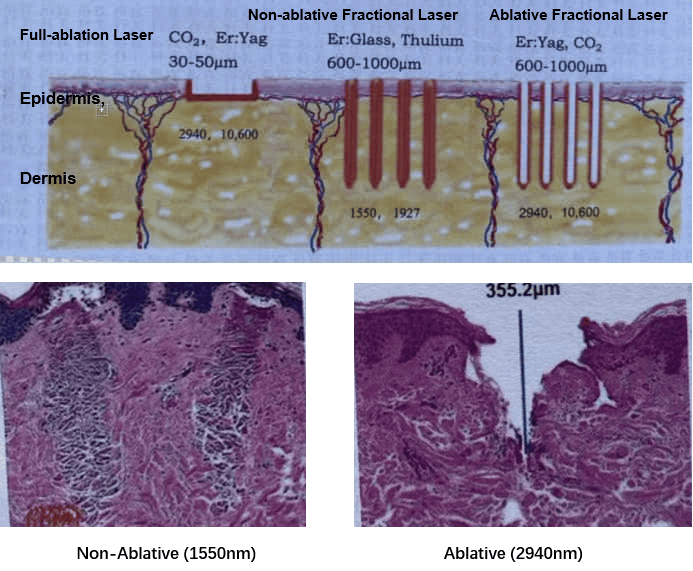
However, the extent of ablation is primarily determined by the laser's water absorption coefficient. Secondarily, it is influenced by the laser's power; higher power settings result in deeper and more significant ablation.
The transition from ablative to sublative to non-ablative treatments reflects a shift in the primary mechanism: from superficial to deep, targeting layers from the epidermis inward, with effects evolving from vaporization to thermal coagulation, then to collagen remodeling, and ultimately to stimulated collagen regeneration.
Jingyue Beauty Ablative Fractional Lasers
Jingyue Beauty Non-Ablative Fractional Lasers
What Is A Fractional Laser Output Modes: Full Beam vs Fractional Output
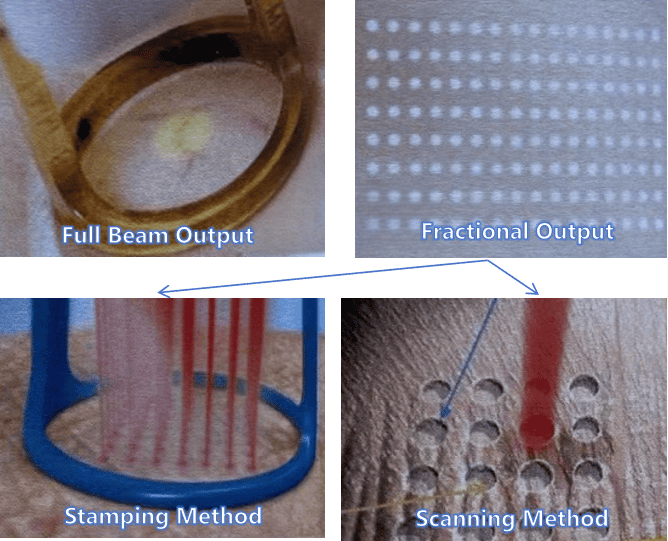
1. Full Beam Output:
2. Fractional Output:
1) Stamping Method:
2) Scanning Method:
What Is A Fractional Laser Cutting Handpiece (Pulsed Operation)
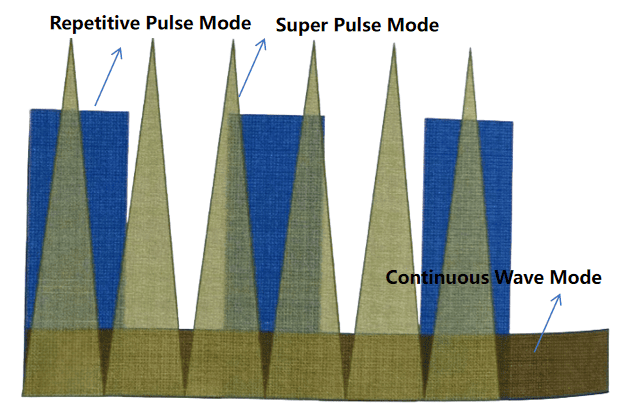
There are the following several cutting methods:
1) Repetitive Pulse Mode (Normal Mode):
- Also called continuous pulse mode
- Adjustable power, pulse width, and pulse interval
- Versatile applications (illustrated as blue square waves)
2) Super Pulse Mode:
- Spike-shaped emission with minimal delay between pulses (yellow spike waveform)
- Suitable for precise tissue cutting
3) Continuous Wave Mode:
- Sustained laser emission (brown rectangular waveform)
- Used for surgical cutting; rarely used in aesthetics due to higher risk
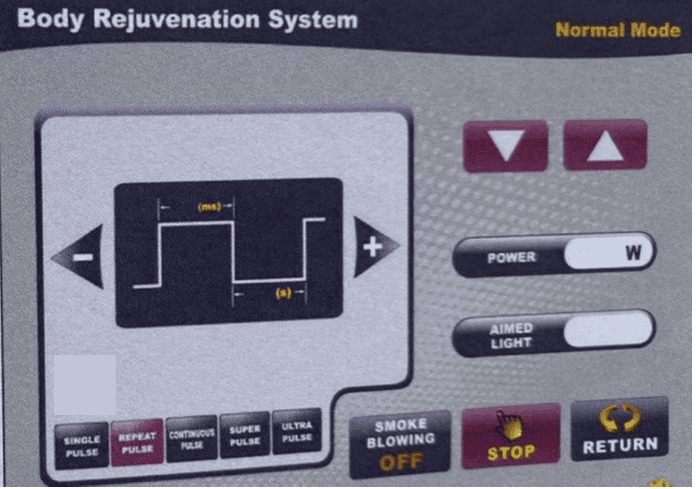
However, the most frequently used mode remains the Repetitive Pulse Mode.
The typical parameter settings for this mode are as follows:
Laser Power (W): 3-5 W (most commonly used)
Pulse Width: 5-10 ms (most commonly used)
Pulse Delay: 50 ms or 100 ms
For laterally cutting protruding hyperplastic tissue, a 100mm focal length handpiece is recommended. For vertical vaporization, such as in the treatment of xanthelasma, a 50mm focal length handpiece is suggested.
During the procedure, the laser emits light in a cyclic "on-pause-on" pattern as long as the footswitch is depressed. Releasing the footswitch immediately stops the emission, ensuring a high level of operational safety.
What Is A Fractional Laser Female Intimate Treatment Mode
Certain fractional laser systems offer a unique functionality known as Intimate Treatment Mode. This specialized feature utilizes localized photothermal effects to stimulate collagen regeneration, thereby addressing various intimate skin concerns. These include improving skin laxity in the private area, reducing pigmentation, and repairing mild scarring. Additionally, the treatment enhances moisture retention and elasticity of the mucosal tissue in the intimate region.
As a minimally invasive technique, it involves relatively short recovery times and is designed to improve both the aesthetic appearance and functional quality of the treated area.
Talk To Jingyue Beauty For More Product Details
What Is A Fractional Laser Post Treatment Skin Response and Repair Mechanism
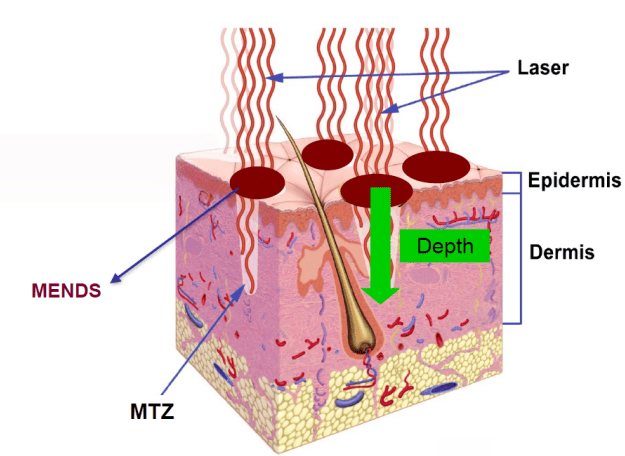
After fractional laser irradiation, the skin exhibits numerous microscopic treatment zones (MTZs), as shown in the accompanying diagram. Depending on the wavelength and water absorption coefficient, two types of immediate reactions may occur:
Ablative vaporization (ablative)
Protein thermal coagulation (non-ablative)
Both types of skin injury trigger regenerative repair processes. Ablative lasers cause vaporization and removal of tissue at the treatment points, stimulating epidermal regeneration and resurfacing. The surrounding and underlying thermal coagulation leads to dermal necrosis and damage, prompting fibroblasts to produce new collagen and elastic fibers, resulting in skin tightening and long-term rejuvenation.
Fractional laser treatments intentionally cause limited and controlled skin damage to activate natural healing processes. The presence of untreated healthy skin between treatment points accelerates recovery, reduces downtime, and minimizes the risk of scarring.
By maintaining a safe "point spacing" between laser impacts, continuous or widespread skin damage is avoided, significantly lowering the probability of adverse effects such as scarring.
What Is Fractional Laser Practical Clinic Usage Situation
|
Laser Type |
What Age To Get Fractional Laser? |
|
Non-Ablative (1927 nm) |
|
|
Ablative Fractional (10600nm CO2) |
|
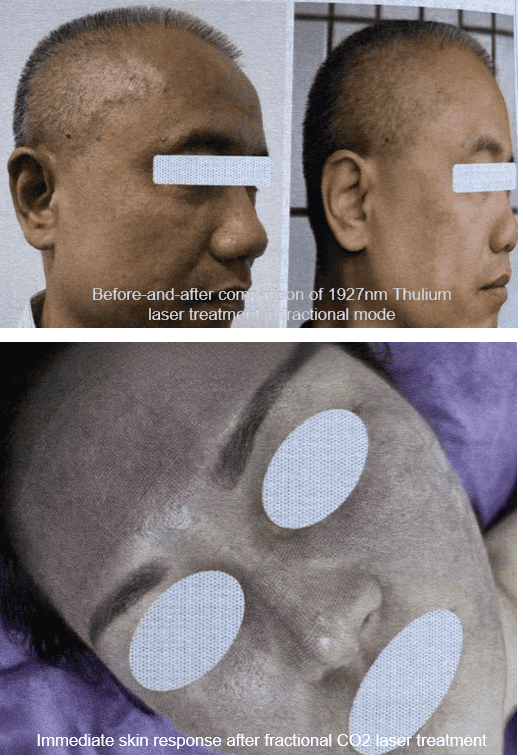
CO2 Fractional Laser Before and After
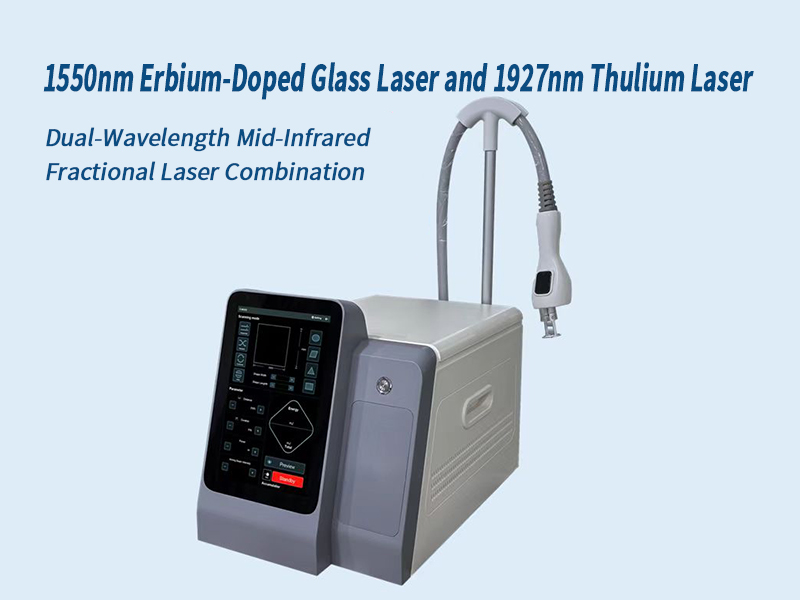
New Product Launch: 1550nm Erbium-Doped Glass Laser and 1927nm Thulium Laser Dual-Wavelength Mid-Infrared Fractional Laser Combination
Related Article