At-Home vs In-Clinic Tattoo Removal: Which Method Delivers Safe and Effective Results?
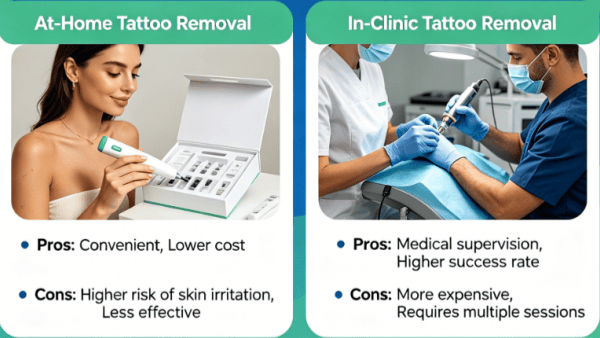
Introduction
A lot of people struggle with tattoos that they no longer want. Whether you regret the style of pattern, the artwork does not reflect you anymore, or the tattoo simply did not come out the way you envisioned it, countless individuals each year seek information about ways to have their tattoos removed. However, as soon as you begin researching, you will realize that there are two starkly different routes available: professional in-office laser tattoo removal treatment and various at-home methods of removing a tattoo.
The choice is rather obvious, yet it is essential to look into the matter deeply and carefully before coming up with an answer: which procedure can actually be effective and which one poses a danger to your health?
Here comes a detailed analysis of the advantages and disadvantages of at-home versus in-clinic tattoo removal.
The Process Behind Laser Tattoo Removal
Before comparing the techniques, let's take a look at what you will be dealing with. Tattoos are meant to last forever. The ink that artists put in your skin penetrates the second layer (the dermis), where its cells are less active than the cells in the epidermis. Moreover, the ink remains deeply entrenched in the skin and is sheltered from natural removal processes and any topical applications.
What laser tattoo removal does is applying the concentrated beams of light energy that break down ink pigments, similar to how Q-switch laser treatment targets unwanted pigmentation in aesthetic dermatology. In their smallest form, the pigments are carried out of the body by the lymphatic system over the period of weeks. This process is not immediate; in order to remove the tattoo completely, you will need several sessions to allow for natural cleansing of the body from debris caused by tattooing.
In other words, professional tattoo removal takes time and effort. This makes home-based solutions even more difficult as far as scientific problems are concerned.
In-Clinic Laser Tattoo Removal: The Golden Standard
If administered by qualified professionals and using cleared laser machines, in-clinic laser tattoo removal represents the safest and most effective solution for full tattoo elimination. Several types of laser systems are approved to be used by or under supervision of a healthcare professional for tattoo lightening or removal purposes.
✅Professional Laser Tattoo Removal – How It Works
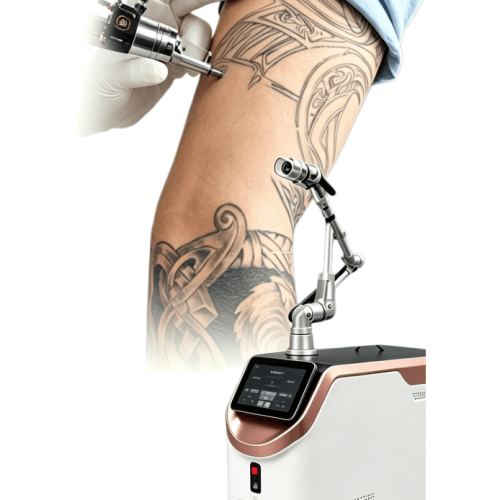
A professional clinic uses special medical-grade laser equipment based on completely different mechanisms compared to any at-home laser machine.
-
Q-switch Lasers: Traditional Approach to Tattoo Removal
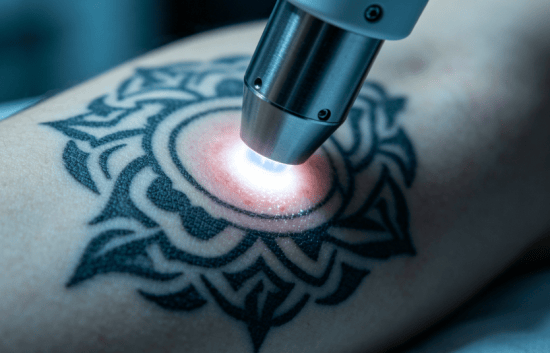
Q-switch laser devices have long been considered the gold standard in tattoo removal thanks to consistent good clinical results, high predictability, and excellent safety. Such lasers produce ultra-short (nanoseconds-long) pulse bursts creating an effect known as photoacoustic effect, which basically means that it fragments the ink granules. The crushed ink particles are tiny enough to get into specialized immune cells called macrophages, which later remove them from the body via lymphatic system.
A modern q-switch laser usually comprises several laser beams. The most popular are 1064nm (Nd:YAG) for treating deeper ink layers as well as dark colors (the beam is also suitable for people with dark complexion) and 532nm (KTP) for red, orange, and yellow pigments. Moreover, some lasers feature additional wavelengths of 755nm or 694nm to target blue and green ink particles.
-
Picosecond Lasers: Modern Approach to Tattoo Removal
Picosecond lasers represent a new approach to the problem of tattoo removal. They operate on even shorter pulse bursts (a trillionth part of a second – picoseconds, which is about 100 times faster than a nanosecond). Such an ultra-short pulse creates a photomechanical effect, which breaks down tattoo ink even further compared to q-switch lasers making it easier to be removed via phagocytosis process.
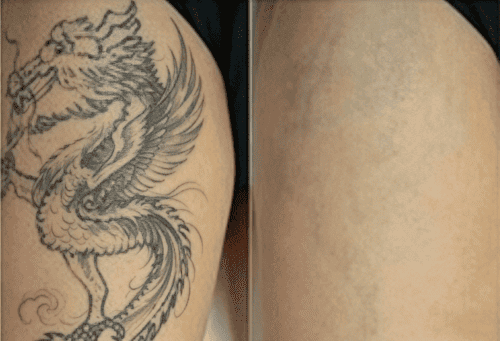
According to clinical studies, the level of tattoo clearance provided by Picosecond laser was higher than 80% among all test subjects. In addition, the researchers noted the clearance rate of 94% of blue and green pigments following 1 or 2 procedures without any pigment alterations and scar formations.
✅Laser Tattoo Removal Procedure and Time Frame
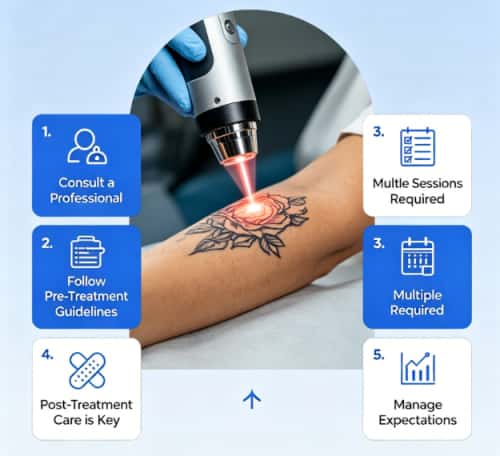
As a rule, professional tattoo removal involves several treatment sessions, and complete tattoo removal takes about 6 to 10 visits. However, the required number of sessions is highly dependent on such parameters as tattoo age, ink color, density, and skin type. For example:
-
It may take 3 to 6 laser sessions to remove a small black tattoo
-
Removing large black tattoos requires 6 to 10 laser treatment sessions
-
Tatoos featuring colorful pigments usually need 6 to 12 sessions
-
Removing cover-ups may take 8 or more sessions
There are about 4 to 8 weeks between visits allowing the body's lymphatic system to eliminate crushed ink particles. The total period for a complete tattoo removal may vary within several months and up to a year.
✅Pain During Tattoo Removal and Its Temporary Side Effects
While pain sensation varies depending on skin sensitivity, many people compare the feeling of getting their tattoo removed with the sensation of a rubber band being snapped. Local anesthesia may be used to minimize discomfort.
Besides, possible side effects are limited to some swelling, redness, and temporary skin whitening ("frosting").Also, laser tattoo removal may leave skin lighter in the treated areas, and potential risks associated with such procedure include the risk of getting scars, infections, pinpoint bleeding, redness, and soreness. But all of those side effects are temporary in nature and can be avoided by choosing a reliable clinic.
✅What Professional Laser Tattoo Removal Costs?
On average, one laser tattoo removal session costs about $250 to $300 in the developed regions of Europe and America. Depending on the size and complexity of a particular tattoo (as well as its color), a clinic may charge between $100 and $500 per visit. Therefore, the total price tag for laser tattoo removal may vary between $1,000 and $5,000 and above.
At-Home Tattoo Removal Techniques
There seems to be nothing appealing about at-home methods to remove tattoos. Lower price and ability to take care of your tattoo on your own. However, there is a big chance this method will disappoint your expectations as well as harm you health.
-
Tattoo Removal Creams
These products are known as tattoo lightening or eraser creams. You simply apply the tattoo removal cream to the area where the tattoo is. Then, it promises to gradually erase it, but there is something to know about these creams first.
Will they work? Not really. There is no way they can penetrate through the top layers of skin and reach the dermis. As we all know, tattoo ink gets deposited in the dermis, which is possible only with the skin broken. At best, these creams bleach the top layer of the skin making the tattoo seem lighter. The moment you stop applying the cream, it will become its previous color.
The dangers associated with the creams are numerous. First and foremost, it causes permanent skin discoloration because of bleaching agents, which results in light spots appearing on the skin. Other adverse effects include severe skin irritation, chemical burns, permanent scarring, and sometimes allergic reactions which can result in serious consequences and even death. There is not one approved tattoo removal cream on the market today.
-
Home-Use Lasers and IPL Machines
Another type of equipment that consumers might consider are tattoo removal devices based on lasers and IPL technologies. These at-home devices have several downsides, the biggest one being the lack of approval. Moreover, at-home devices cannot deliver proper treatment because of the lack of medical grade equipment used and professional supervision that is crucial when performing such procedures.
As for the safety factor, it is much higher than in case with tattoo removal creams. Risks associated with home-based removal of tattoos are numerous, among which there are such factors as permanent scarring, burns, infections, and even darker tattoo because of the procedure. This occurs because at-home devices do not use selective photothermolysis principle that makes professional laser tattoo removals safe and effective.
-
Cost Benefits or Trade-Off?
When considering tattoo removal techniques, people tend to pay attention to costs. Usually, home tattoo removal costs between $50-$150 per bottle, while each session of tattoo removal using the medical-grade laser may cost up to $600-700. It means that even if the product works, you will need numerous bottles to get rid of the tattoo.
Comparison Summary: At-Home vs In-Clinic Tattoo Removal
Factor |
In-Clinic Laser Tattoo Removal |
At-Home Tattoo Removal |
|---|---|---|
|
Cost per session / product |
$200–$500 per session |
$50–$150 per product |
|
Total cost for full removal |
$1,000–$5,000+ |
$50–$500 (with no results) |
|
Approval |
Yes—all medical lasers are cleared |
No—no home device or cream has clearance for tattoo removal |
|
Safety |
High—professional oversight, calibrated settings |
Very low—risk of burns, scarring, infection, permanent discoloration |
|
Effectiveness for complete removal |
80–95% clearance possible with sufficient sessions |
Near zero—creams cannot reach dermis; DIY lasers lack power |
|
Professional oversight |
Yes—trained medical provider |
None |
|
Risk of permanent scarring |
Minimal when performed correctly |
High—especially from chemical burns and improper laser use |
|
Pain management |
Topical anesthesia available |
None |
|
Time investment |
6–10 sessions over 6–12 months |
Unlimited (creams require daily application for a year or more) |
Which Method Is Right for You?
-
Choose In-Clinic Laser Tattoo Removal If:
-
You wish to get total removal. Only professional laser tattoo removal is guaranteed to remove a tattoo without scaring you.
-
Your tattoo was done professionally. Colorful tattoos or big-sized tattoos require advanced laser tattoo removal devices, which can operate at different wavelengths to achieve better results.
-
Your health matters to you. It is always safer to turn to approved devices run by professionals.
-
Your skin is dark (Fitzpatrick IV-VI). A professional laser tattoo removal clinic will provide you with appropriate wavelengths for darker skin (for example, Nd:YAG with a wavelength of 1064 nm).
-
You have already attempted at-home solutions before. Professional grade picosecond lasers are very efficient when treating recalcitrant tattoos.
-
You are looking for business to business partnerships. Buying a professional grade device for laser tattoo removal will help you create a reliable brand in the market.
-
At-Home Tattoo Removal Should Never Be Considered by Those Seeking Complete, Safe Removal
Data clearly proves that any at-home removal technique cannot be considered effective for complete tattoo removal and is potentially harmful to your skin. There is only one situation when home-based solution may be acceptable: when you would like to partially remove some old, tiny tattoo and you are ready to put up with high risk of permanent skin injury.
Making the Right Decision: A Professional's Point of View
Should you choose to undergo tattoo removal, the selection between at-home vs in-clinic tattoo removal should not be based purely on initial prices. Tattoo removal is a medical procedure, not an aesthetic one.
The tattoo ink lies very deep in the dermis and needs to be safely removed with the use of special, highly effective technology provided by experts, just as choosing the best laser hair removal machine requires matching technology to skin type and safety needs.
-
If you seek removal:
You need to consult a dermatologist or other professional at a reputable tattoo removal clinic. This specialist will analyze your tattoo, determine its properties, discuss your objectives, and create an individualized treatment protocol involving the proper tattoo removal laser, Q-switch or Picosecond. Don't forget to ask about packages that allow you to save on the procedure overall.
-
If you're in a B2B partnership with tattoo removal clinics or are the owner yourself:
The demand for this procedure is only increasing, as the number of people wanting to get rid of tattoos is constantly growing, making it crucial to understand how much a laser tattoo removal machine costs and what affects that investment. You can benefit from investing in approved lasers for tattoo removal, whether it be Q-switch lasers or picoseconds, and complementing your portfolio with professional laser hair removal machines or even 3-in-1 IPL and photorejuvenation devices for broader aesthetic services.
Home-based approaches may pose competition in terms of cost, but can't compete in terms of results or safety. In most cases, clients who try at-home procedures and end up injured turn into your best-selling customers.
Conclusion
Clinic-based removal treatments by professional personnel are the most secure ways of completely getting rid of tattoos, using approved techniques which reduce chances of scarring. Although the treatment may cost up to $200-$500, it's worth it because home-made alternatives don't give the same results and also pose very serious dangers such as scarring, burns, infections, and even blindness.
Don't cheap out on your skin, and especially not when it concerns something like tattoo removal, as any compromise with quality could turn out to be a costly mistake, both physically and psychologically.
How to Remove Temporary Tattoos: 7 Safe and Effective Ways For All Skin Types
Professional Vs Home Tattoo Removal Devices: Which One Delivers Real Results?
Related Article