Does Laser Hair Removal Affect Tattoos?
Introduction
The Growing Demand for Hair Removal on Tattooed Skin Modern social progress combined with self-expression gave rise to two simultaneous beauty phenomena: laser hair removal and tattoos. Increasing numbers of individuals choose smooth and hairless skin and display their artistic creations. However, a question may arise – what if they want hair removal near or over their tattoo?
If you manage a beauty salon or a laser center, sell aesthetic devices or wholesale laser hair removal equipment, the following issue has surely occurred more than once in your practice. "Can laser hair removal affect a tattoo?" Yes, it definitely can. The detailed information on what precautions to take to avoid damage and provide a positive experience to your clients is presented below.
We will review:
-
Why laser hair removal and tattoo interaction occurs
-
The difference between laser tattoo removal and laser hair removal
-
Methods to save a tattoo during laser hair removal
-
When to offer electrolysis instead of lasers for tattooed skin
-
How a laser device manufacturer or wholesale laser distributor can leverage this challenge
At the end, you will learn how to handle laser hair removal on tattooed skin and satisfy each of your clients' needs.
How Laser Hair Removal Works (And Why It Targets Tattoos)
Before we answer "Does laser hair removal damage a tattoo?", we need to look at the technology behind the procedure.
✅ The Physics of Selective Photothermolysis
Laser hair removal devices emit a certain wavelength of light energy (755 nm, 808 nm, and 1064 nm being the most common ones) which is selectively absorbed by melanin pigment contained in hair follicles. Melanin transforms energy into heat and destroys follicle's capability to produce new hairs. Such mechanism is called selective photothermolysis: damage the follicle but not the surrounding tissue.
However, melanin is not the only dark substance in the skin. Tattoo pigment can also absorb laser energy and transform it into heat.
✅ Laser Tattoo Removal vs Laser Hair Removal – A Fundamental Difference
It may sound confusing, but there are major differences between these two procedures that must be clearly understood to ensure successful operation:
Aspect |
Laser Hair Removal |
Laser Tattoo Removal |
| Target | Melanin in hair follicle | Particles of ink in dermis layer |
| Mechanism | Selective photothermolysis | Photoacoustic disruption |
| Wavelength | Single (usually 755, 808, or 1064 nm) | Multiple (532, 755, 1064 nm for different ink colors) |
|
End result |
Hair removal Discoloration | ink particle destruction |

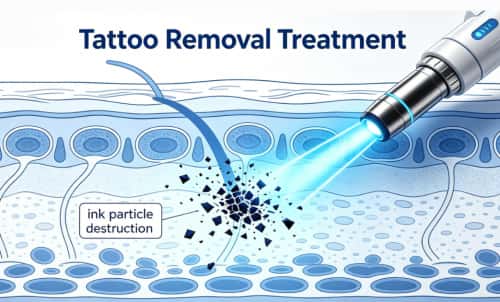
Thus, laser tattoo removal vs laser hair removal are two diametrically opposite procedures. The former attempts to preserve ink particles, the latter tries to destroy the ink pigment, and often relies on specialized technologies such as Pico laser and Q‑switched laser systems. Hence, laser hair removal on tattooed skin inevitably leads to its destruction due to uncontrolled absorption.
Does Laser Hair Removal Affect Tattoos? The Direct Answer
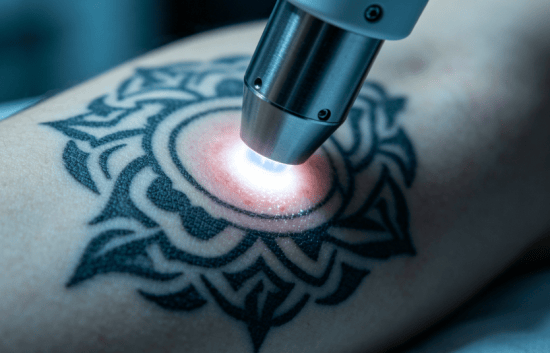
Yes, laser hair removal will undoubtedly damage tattoos unless certain measures are taken beforehand. Discoloration, burn injuries, and loss of tattoo integrity are likely results.
✅ Why Tattoo Ink Absorbs Laser Energy
Tattoos are created with the help of pigment which is placed deep under the epidermis layer into the dermis. Tattoo ink is usually dark or colored which means high efficiency of light absorption in this part of the skin. When such skin is exposed to a laser hair removal device:
-
The pigment molecules absorb the energy instantaneously;
-
Temperatures in the irradiated zone reach 70 °C and higher;
-
These changes result in thermal damage to epidermis and dermis layers;
Consequently, laser hair removal on tattooed skin does not result in removal of the tattoo, but in its unwanted alteration or complete destruction.
✅ The Outcomes of Laser-Hair Removal-Tattoo Interaction – Injury
Numerous clinical observations and case studies confirm these conclusions. If you attempt laser hair removal in or near an area containing a tattoo, you will likely face the following consequences; in contrast, choosing the best laser platforms dedicated to tattoo removal helps practitioners manage ink safely and effectively:
-
Burn injuries (first-degree to second-degree burns);
-
Permanent hypopigmentation/hyperpigmentation of the affected skin;
-
Distortion or disappearance of tattoo design;
-
Formation of hypertrophic or keloid scars;
In short, does laser hair removal affect a tattoo? Definitely – it may ruin your efforts to remove unwanted hair and harm a tattoo as well.
How to Protect Tattoos During Laser Hair Removal (Actionable for Clinics)
Now some good news: if you apply appropriate procedures, laser hair removal affect tattoos is not an obstacle. If you manufacture and wholesale laser hair removal equipment, teach all operators how to act correctly and ensure they understand how to choose the best laser hair removal machine for different skin and hair types.
✅ Tattoo Protective Methods
The most efficient approach in protecting a tattoo from laser energy is physical occlusion. You need to use opaque, white protective tapes which reflect rather than absorb light.
-
Cover a tattoo with at least two layers of the tape, leaving a 1 cm-wide border;
-
For complex tattoos, apply zinc oxide pastes over the taped skin;
-
Never use dark or colored tape – they will absorb laser energy;
✅ Safety Margin for Tattoos – 2–3 Cm Rule
Despite protective measures, some part of laser energy will still reach the tattooed skin area. Thus, you must leave a non-irradiated zone of 2–3 cm wide between tattoo and treatment site.
-
Do not expose tattoo border region to laser energy;
-
Remove remaining hairs in this zone manually;
For beauty centers, this means laser hair removal can only be carried out with a 2–3 cm safety margin around the tattooed skin area.
✅ Waiting 12 Weeks Before a First Procedure After Getting a New Tattoo
Never start hair removal in the next 12 weeks after a new tattoo was applied to skin. New ink is surrounded by healing tissues and inflammatory processes, hence the risk of burns, infections, and total loss of ink. Remember to ask all clients about their tattoos and the time when they got it done.
Alternative Solutions for Tattooed Skin – When to Stop Using Laser
In cases when tattoo completely covers the targeted area, laser hair removal is not an option anymore. For example, when there is a full sleeve tattoo on an arm or a large body piece on your back. In such scenarios, light‑based hair removal is contraindicated, but Q‑switch laser treatment remains suitable for targeted pigmentation and tattoo work. Here are alternatives for such cases:
✅ Electrolysis – The Ideal Solution for Tattoos
This method is the best choice if laser hair removal affect tattoos is expected.
-
How it works: a special thin needle is inserted into hair follicle where it emits low-energy electricity destroying a follicle either chemically or thermally.
-
How it affects tattoos: since electrolysis does not depend on light energy absorption, it can be performed on any skin type and color, including tattooed skin areas.
-
Cons: electrolysis is slower and involves more sessions (12-18 per year); it removes hairs individually, so it takes time.
Thus, electrolysis for tattooed skin gives your beauty salon competitive advantages. First, it allows serving customers whom competing clinics cannot work with. Secondly, if you combine electrolysis for small areas (eyebrows, lips), you will increase your revenue greatly, just as understanding how much laser tattoo removal typically costs helps you structure profitable and transparent pricing for other services.
✅ Other Temporary Hair Removal Methods for Small Tattoos
There are options for those clients whose desire is not permanent hair removal, but removing unwanted hairs on their tattoo. They include:
-
Shaving: a quick and inexpensive method for short-term hair removal
-
Using depilatories: effective, but potentially harmful if you apply the cream to tattoo
In such a way, laser hair removal affect tattoos is not the problem any longer.
Practical Guide for Laser Distributors & Beauty Centers
As a wholesaler or B2B buyer of aesthetic devices, you need not only provide the product, but also educate your potential clients. Reviewing the landscape of professional laser hair removal machines on the market will help you position your offerings more competitively. This article is the opportunity to demonstrate your competence in the matter and build trust relations with future customers.
✅ Tattoo-Safe Client Interview for Hair Removal
Here is a list of questions you need to ask before performing hair removal on a client:
-
Does your skin in the treatment area have tattoos?
-
What is the age of your tattoo?
-
Is your tattoo colored or just black?
-
Are you ready for a 2–3 cm wide safety margin around the tattoo?
Do not skip any of these questions – this will prevent many problems. Also, take pictures to document your client's situation and explain why you need these questions.
✅ Training Your Staff for Working With Tattoos
All operators working with clients must be trained for protecting tattooed skin during hair removal process; at the same time, clinics investing in professional tattoo removal machines from Jingyue Beauty should receive detailed protocols on safe use around existing ink:
-
Applying tattoo cover tapes correctly;
-
Understanding types of tattoos (professional, amateur, cosmetic);
-
Adjusting spot size and intensity when approaching tattooed area;
Remember to conduct training seminars every quarter, or even monthly to minimize risks.
✅ Tips for Selling Aesthetic Devices to Wholesalers
As a wholesale laser hair removal device producer, you must warn your buyers about laser hair removal affect tattoos. This is a matter of safety for their business and their clients, just as providing clear information on the cost of investing in a laser tattoo removal machine is essential for sound business planning.
-
Provide tattoo safety protocols to each new customer;
-
Offer online training courses for their specialists;
-
Warn about liability and put disclaimer regarding tattooed skin on your products;
Such steps will increase sales, prevent return of goods, and build lasting partnerships.
Things Every Customer Should Know (Tips for End Users)
Customers themselves should be aware of possible dangers to tattoos during hair removal procedures.
1) Pre-Procedure Recommendations for Tattoo Owners
Discuss every tattoo on your body with a specialist who will perform hair removal procedure:
-
Leave the tape in place until the procedure ends even if it is uncomfortable;
-
Know that only hairs within the safe distance from tattooed skin will be removed;
-
If you are going to undergo hair removal, refuse laser treatment near any tattoos.
2) Post-Procedure Care for Hair Removal in or Near Tattoos
-
Keep treated skin clean and lubricated;
-
Protect both tattoo and laser treatment area from UV exposure;
-
If you notice any unusual changes in tattoo, call your specialist immediately; in some cases, devices like Q‑switched lasers used for tattoo and pigment treatment may be considered later under professional guidance.
Conclusion – Finding the Right Balance
To conclude "Will laser hair removal affect tattoos?" – Yes, it does so very actively. However, with some preparation and knowledge, it is possible to remove hairs on tattooed skin safely.
For beauty centers: learn how to use tattoo barriers and safety margin to achieve success and reputation.
For laser device manufacturers and wholesale distributors: educate B2B clients to avoid liability and grow your business.
For customers: always discuss your tattoos and be aware of risks.
With these tips and approaches, the aesthetic industry will be able to satisfy growing requests of modern consumers.
Frequently Asked Questions (FAQ)
Q1: Can I get hair removal in a tattooed area if the technician uses a low setting?
No, it is not safe enough because laser energy remains high enough to cause burning and ink fading.
Q2: How long should I wait after tattoo application to remove hairs?
You will have to wait for 12 weeks to avoid skin injury.
Q3: Is electrolysis painful if performed over tattoos?
No, it is not. Electrolisis causes brief stinging sensation but does not affect the tattoo itself.
Q4: Will laser hair removal on white tattoo fade it faster?
Not necessarily. White ink will be heated and turn brownish or grayish. Lighter inks are also unpredictable.
Q5: Am I liable if I damage my client's tattoo with a laser device?
Yes, tattoos are considered valuable properties.
How to Remove Eyebrow Tattoo: The Complete Guide to Safe and Effective Eyebrow Tattoo Removal
How to Become a Tattoo Removal Technician
Related Article